Amazon Business Model: How Amazon Makes Money and How It Works
The Amazon business model is much broader than online retail. Amazon combines direct product sales, a third-party marketplace, subscription services, cloud computing, advertising, and fulfillment infrastructure within one connected ecosystem. These businesses serve different customer groups and generate revenue in different ways. Understanding how they fit together matters because Amazon’s scale comes from multiple services supporting one another, not from a single product or revenue stream.
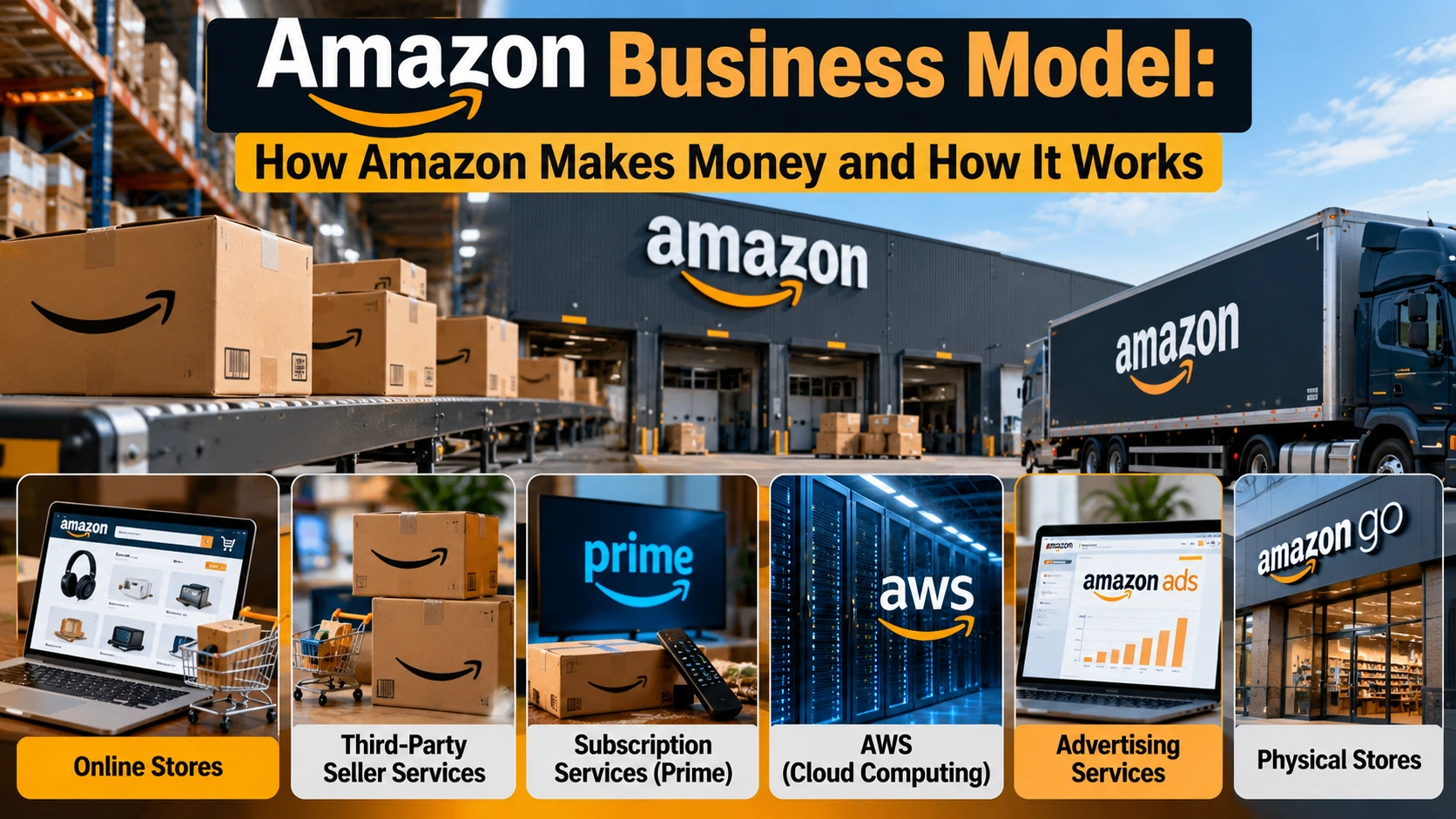
The Amazon business model combines first-party retail, third-party seller services, Prime subscriptions, AWS cloud computing, advertising, and fulfillment. Amazon earns money from product sales, seller fees, subscriptions, cloud usage, and advertising. These revenue streams operate differently but connect through Amazon’s broader customer, seller, logistics, and technology ecosystem.
What Is the Amazon Business Model?
Amazon operates as a diversified commerce and technology company, not just a traditional retailer. Its business model combines products, services, infrastructure, and digital platforms to serve consumers, sellers, advertisers, developers, and businesses.
On the consumer side, Amazon sells products directly and also provides a marketplace where independent merchants can sell their own inventory. It earns additional revenue from subscriptions, seller services, advertising, and fulfillment.
Amazon also operates Amazon Web Services, or AWS, which provides cloud infrastructure and technology services to organizations worldwide. This gives Amazon a major business that is not directly dependent on consumer e-commerce activity. The overall model is therefore built around several connected revenue engines rather than one source of income.
How Does Amazon Make Money?
Amazon makes money by charging different customers for different value. Consumers pay for products and subscriptions. Third-party sellers pay referral fees, fulfillment charges, shipping fees, advertising costs, and other service fees. Advertisers pay for sponsored placements and other advertising formats.
AWS customers pay for cloud computing, storage, databases, networking, analytics, artificial intelligence, and related technology services. This diversification matters because each business has different cost structures and economics. Retail relies heavily on inventory, fulfillment, labor, and delivery, while AWS is based on technology infrastructure and cloud usage.
Amazon’s Main Revenue Streams
Amazon reported approximately $716.9 billion in net sales in 2025. Its revenue came from several major categories.
| Revenue Stream | How Amazon Earns Money |
| Online stores | Direct sales of products and digital content |
| Physical stores | Sales through physical retail locations |
| Third-party seller services | Commissions, fulfillment, shipping, and related fees |
| Subscription services | Prime and certain digital subscriptions |
| AWS | Cloud infrastructure and technology services |
| Advertising services | Sponsored ads, display, video, and related advertising |
| Other | Smaller service and business activities |
These categories show why Amazon should not be viewed as a single-channel e-commerce retailer.
First-Party Online and Physical Retail
Amazon directly sells products to customers through online and physical stores. In this model, Amazon may purchase inventory from manufacturers or distributors, set prices, process orders, and manage fulfillment. Online stores remained Amazon’s largest individual revenue category in 2025. However, high retail revenue does not automatically mean high profitability. Retail involves substantial costs related to inventory, warehouses, shipping, labor, returns, and customer service.
Third-Party Seller Services
Amazon also operates a marketplace where independent sellers can offer products to Amazon customers. Instead of earning the full value of every third-party product sold, Amazon generally earns money from the services connected to those transactions. These can include referral commissions, fulfillment fees, shipping charges, storage fees, and other seller services.
This distinction is important because the total value of products sold by third-party sellers is not the same as Amazon’s recognized seller-services revenue. Amazon has said that independent sellers account for more than 60% of sales in its store, showing how important marketplace sellers are to its wider commerce ecosystem.
Amazon Prime and Subscription Services
Amazon earns recurring revenue through subscription services, including Prime membership fees and certain digital subscriptions. Prime is strategically important because it connects customers to multiple benefits within the Amazon ecosystem. Depending on the market, these may include delivery benefits, entertainment, and other services.
Subscription services generated roughly $49.6 billion in revenue in 2025. However, Prime’s value isn’t limited to membership fees. It also helps Amazon maintain an ongoing relationship with customers across several services.
Amazon Web Services
AWS provides cloud computing, storage, databases, networking, analytics, artificial intelligence, and other technology services. Its customer base includes businesses, startups, governments, and other organizations rather than primarily retail shoppers.
Amazon reported approximately $128.7 billion in AWS net sales in 2025. AWS is a major revenue source for Amazon, with economics that differ significantly from physical retail. This diversification reduces Amazon’s dependence on e-commerce alone.
Amazon Advertising
Amazon also generates substantial advertising revenue. Sellers, brands, publishers, and other advertisers can pay for sponsored product placements, display ads, video ads, and related services across Amazon properties. Advertising-services revenue reached approximately $68.6 billion in 2025.
Amazon’s advertising model benefits from shopper intent. Many users are already researching or comparing products when they see ads, making those placements valuable to advertisers trying to reach customers close to a purchase decision.
Other Revenue Sources
Amazon also earns revenue from smaller business activities that fall outside its largest categories. These can include certain shipping services, healthcare services, video licensing and distribution, co-branded credit-card agreements, and other activities.
Individually, these areas are smaller than Amazon’s major revenue categories, but they still contribute to overall diversification.
How the Amazon Marketplace Model Works
The marketplace lets independent sellers reach Amazon’s customer base without Amazon owning every product listed on the platform. A seller creates listings and can either fulfill orders independently or use Amazon’s fulfillment services. When a transaction occurs, Amazon may collect a referral fee and other service charges.
This creates value on both sides of the marketplace. Customers gain access to a wider selection of products, while sellers gain access to Amazon’s traffic, payments, technology, and logistics infrastructure.
The model can also create network effects. More sellers can increase selection, which may attract more customers. A larger customer base can then make the marketplace more attractive to additional sellers and advertisers. However, this cycle is not guaranteed. Seller costs, pricing, competition, marketplace policies, regulation, and customer experience can all affect how effectively the marketplace performs.
How Fulfillment by Amazon Supports the Model
Fulfillment by Amazon, commonly known as FBA, allows third-party sellers to store products in Amazon’s fulfillment network. Amazon can then handle storage, packing, shipping, customer service, and certain returns for those sellers.
FBA helps Amazon monetize its logistics infrastructure while reducing the operational burden on sellers who don’t want to build their own large fulfillment systems. It also connects marketplace activity with Amazon’s logistics network. Sellers can use Amazon as both a sales platform and a fulfillment provider. FBA is not a separate major reporting segment. It is better understood as part of Amazon’s broader third-party seller-services ecosystem.
Why Prime Matters to Amazon
Prime helps Amazon build longer-term customer relationships. Instead of interacting with Amazon only when they need a product, Prime members receive a package of ongoing benefits. This gives customers more reasons to stay engaged with Amazon over time.
Prime also links several parts of the ecosystem. Shopping, delivery, digital entertainment, and subscriptions can all sit within the same customer relationship. That makes Prime valuable beyond the membership fee itself. It acts as both a subscription product and an engagement mechanism that connects customers with other Amazon services. Still, customer behavior varies, and not every Prime member uses the service in the same way.
Why AWS Is Important to Amazon
AWS gives Amazon a major business outside traditional retail. Cloud customers pay for technology resources rather than physical goods. This means AWS has a different customer base, cost structure, and competitive environment from Amazon’s retail operations. The business also provides diversification. Retail and cloud computing do not depend on the same demand patterns, which gives Amazon exposure to different markets.
AWS strengthens Amazon’s identity as both a commerce company and a technology provider. Its services in computing, storage, networking, security, databases, and AI also position Amazon within the broader enterprise technology market.
How Advertising Fits Into the Ecosystem
Advertising is closely connected to Amazon’s marketplace. Third-party sellers and brands compete for visibility, and sponsored placements let them pay for extra exposure when shoppers search for or browse relevant products. This creates another way for Amazon to monetize marketplace activity beyond seller fees and fulfillment.
Advertising can be particularly valuable because many Amazon users already have purchase intent. A shopper searching for a product may be closer to buying than a user casually browsing a general social or media platform. Even so, Amazon still competes with other large digital advertising platforms for advertiser budgets.
Amazon Business Model Competitive Advantages
Amazon benefits from scale across customers, sellers, infrastructure, and technology. Its marketplace can create network effects: a larger seller base increases product selection, while a larger customer base makes Amazon more attractive to sellers and advertisers. Prime can strengthen customer engagement, and the fulfillment network supports both Amazon’s own retail operations and independent sellers.
The strongest advantage may be the way these businesses connect. Marketplace activity can generate seller fees and advertising demand. FBA supports sellers. Prime connects customers to multiple services. AWS provides a separate technology revenue engine. These relationships make the wider ecosystem more important than any single Amazon business.
Challenges and Risks
Amazon’s scale also creates significant complexity. Retail and logistics require large investments in warehouses, transportation, technology, labor, inventory, and customer service. Managing these costs is especially important in lower-margin parts of the business.
Amazon also faces intense competition across e-commerce, cloud computing, advertising, entertainment, and logistics Regulatory scrutiny is another risk. Large digital platforms face ongoing scrutiny over competition, marketplace practices, seller relationships, data, and consumer protection.
Third-party sellers are important to Amazon’s marketplace, so seller economics and satisfaction matter. AWS also operates in a highly competitive cloud market, while Amazon advertising competes for budgets with other digital platforms. Managing all of these businesses at global scale requires constant operational investment and execution.
Is Amazon’s Business Model Sustainable?
Amazon’s diversification gives it several ways to generate revenue, but long-term sustainability depends on continued execution. Retail, cloud, advertising, subscriptions, marketplace services, and fulfillment each face different competitive pressures. Strength in one area does not eliminate challenges elsewhere.
Amazon benefits from scale, technology, customer reach, and interconnected services. At the same time, it must control costs, maintain seller relationships, compete in technology and advertising markets, and respond to regulatory pressure. The sustainability of the Amazon business model therefore depends on how effectively the company continues managing the entire ecosystem rather than relying on one revenue stream.
FAQs
What is the Amazon business model?
The Amazon business model combines direct retail, a third-party marketplace, subscriptions, cloud computing, advertising, fulfillment, and other services. Amazon earns revenue from consumers, sellers, advertisers, and business customers.
What are Amazon’s largest revenue streams?
Amazon’s major revenue sources include online stores, third-party seller services, AWS, advertising, subscription services, and physical stores. Online retail remains a major source of sales, while AWS, seller services, and advertising are also substantial businesses.
How does Amazon make money from third-party sellers?
Amazon earns revenue from referral commissions, fulfillment services, shipping, storage, advertising, and other seller-related fees. The total value of products sold by third-party merchants is not the same as Amazon’s seller-services revenue.
How does Amazon Prime support the business model?
Prime generates subscription revenue and connects customers to Amazon’s broader ecosystem, including shopping, delivery, digital entertainment, and other benefits.
Why is AWS important to Amazon?
AWS gives Amazon a major cloud-computing business with customers and economics that differ from e-commerce. It adds diversification and generates revenue from enterprise and technology services.
Is Amazon mainly an ecommerce company?
E-commerce remains central to Amazon, but the company also operates major businesses in cloud computing, advertising, subscriptions, fulfillment, and digital services. Describing Amazon only as an online retailer would therefore be incomplete.
Final Thoughts
Amazon’s business model is built around several connected revenue streams rather than a single retail operation. Direct commerce, third-party sellers, Prime, AWS, advertising, and fulfillment each play different roles, while their interaction helps Amazon serve consumers, businesses, sellers, and advertisers through one wider ecosystem.