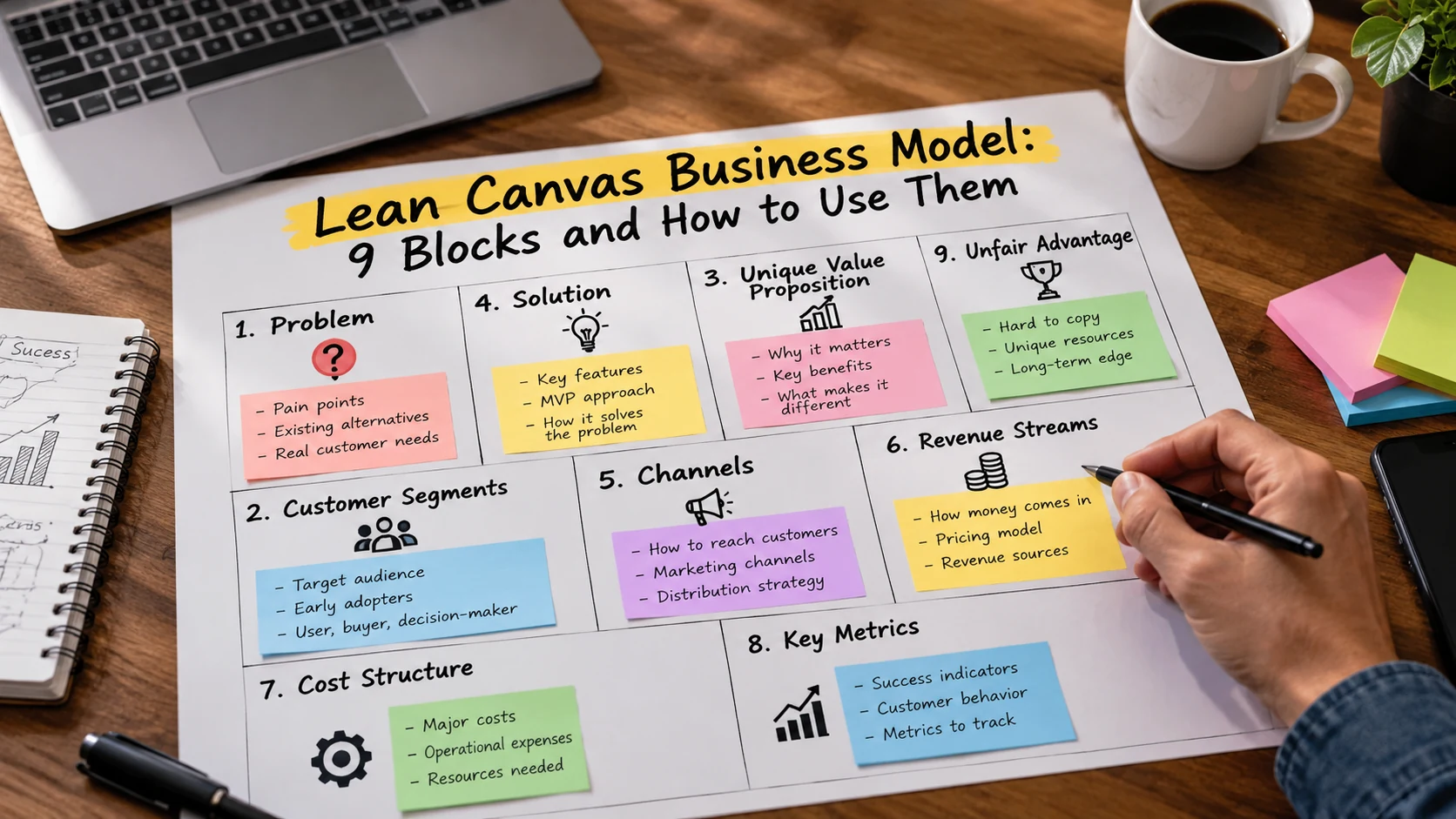
Lean Canvas Business Model: 9 Blocks and How to Use Them
A Lean Canvas business model gives founders a concise way to map the assumptions behind a startup idea before committing heavily to development. Instead of beginning with a long planning document, teams can examine the customer problem, proposed solution, value proposition, channels, revenue, costs, metrics, and potential competitive advantage on one page. The canvas works best when teams treat those assumptions as questions to test rather than proven facts.
A Lean Canvas business model is a one-page startup framework for mapping important assumptions across nine core blocks: problem, customers, value proposition, solution, channels, revenue, costs, metrics, and unfair advantage. Its purpose is not to validate an idea automatically, but to expose risk, guide experiments, gather evidence, and improve the model over time.
What Is a Lean Canvas Business Model?
Lean Canvas is a one-page framework created by Ash Maurya as an adaptation of the broader Business Model Canvas. It is particularly useful for early-stage ventures where major questions about customers, demand, pricing, channels, and the solution remain uncertain.
Rather than describing every operational detail, the framework makes important beliefs visible. A startup may believe that a customer has a serious problem, will pay for a solution, and can be reached through a particular channel. Lean Canvas provides a structured place to write those assumptions down and decide which ones need evidence first. Completing the canvas is not the same as validating the business.
What Is the Purpose of Lean Canvas?
Lean Canvas helps reduce a complicated startup idea into a manageable set of connected assumptions. Founders can use it to identify gaps, compare alternative models, prioritize risk, and update their thinking as customer and market evidence changes.
Map → Prioritize → Test → Learn → Update
The goal is not to create a perfect one-page document. The goal is to understand which assumptions could break the business model and learn about them before unnecessary time and money are committed.
What Are the 9 Lean Canvas Blocks?
The framework is commonly organized around nine core blocks.
| Problem | What important problem exists? |
| Customer Segments | Who experiences the problem? |
| Unique Value Proposition | Why should they care? |
| Solution | What are we proposing? |
| Channels | How will we reach customers? |
| Revenue Streams | How will money come in? |
| Cost Structure | What will the model cost? |
| Key Metrics | What behavior signals progress? |
| Unfair Advantage | What may become difficult to copy? |
Supporting concepts such as Existing Alternatives, Early Adopters, and a High-Level Concept can be considered within the relevant blocks.
1. Problem
The Problem block identifies the customer problems the startup believes are important enough to solve. Founders should begin with customer behavior rather than designing a product first and then searching for a reason people might need it.
Existing alternatives are useful evidence. Customers may already use competing software, spreadsheets, email, manual processes, agencies, or simply tolerate the problem.
Useful questions include how frequently the problem occurs, what customers currently do about it, and whether they already spend time, money, or effort trying to solve it. A problem that sounds inconvenient is not automatically important enough to support a business.
2. Customer Segments
Customer Segments define who experiences the problem and who the startup intends to serve. Broad labels such as “small businesses” or “online workers” usually provide too little direction for meaningful testing.
In B2B markets, the user, buyer, and decision-maker may also be different people. An employee might use the product, a manager may select it, and another person may control the budget. A sharper segment makes it easier to evaluate the problem, value proposition, channel, and willingness to pay.
Early Adopters
Early adopters are a narrower subgroup that may experience the problem more intensely or have stronger reasons to try an early solution. For example, instead of targeting all small businesses, a startup might initially focus on small remote agencies managing several client projects through disconnected tools. That makes testing more focused, but early adopters still need to demonstrate real interest or commitment.
3. Unique Value Proposition
The Unique Value Proposition, or UVP, explains why a particular customer should care about the offer. A feature-focused statement such as “AI-powered project management software” says what the product contains but not why it matters. A stronger statement might be:
Help small remote teams coordinate client work without switching between multiple tools.
Problem → Desired Outcome → Main Benefit → Why This Offer
A strong UVP connects the customer’s problem with a meaningful result rather than simply listing technology or features.
High-Level Concept
A High-Level Concept is a short comparison that makes an unfamiliar product easier to understand, sometimes through an “X for Y” style description. It can support communication, but it does not replace the UVP. A memorable comparison still needs evidence that customers value the underlying offer.
4. Solution
The Solution block outlines the proposed response to the problem. At an early stage, this section should remain small. The startup does not need a complete product roadmap before testing whether the problem and value proposition are meaningful.
A prototype, limited MVP, manual service, concierge workflow, or small feature set may be enough to test the core assumption. Building more features does not necessarily produce more learning.
5. Channels
Channels describe how the startup expects to reach early customers. Depending on the audience, channels might include search, content, direct sales, paid acquisition, referrals, communities, partnerships, marketplaces, or product-led growth.
The useful question is not which marketing channel is fashionable. It is where the specific customer already discovers, evaluates, and purchases solutions. Acquisition and delivery can also happen through different channels. A SaaS company might acquire customers through outbound sales but deliver its service through a web application.
6. Revenue Streams
Revenue Streams explain how the business expects to earn money. Possible mechanisms include subscriptions, one-time sales, usage-based charges, commissions, transaction fees, licensing, and service fees. A SaaS business model, for example, may charge customers monthly or annually for continued access.
A revenue stream describes how money enters the business; it is not the same as a revenue forecast. Pricing should also be treated as an assumption. Customer interest does not prove willingness to pay. Actual purchasing behavior provides stronger evidence.
7. Cost Structure
Cost Structure identifies the major expenses required to test and operate the model. Common costs may include development, hosting, payroll, sales, marketing, customer support, payment processing, software tools, and partner fees. Early-stage businesses should also consider the cost of learning through prototypes, acquisition tests, sales effort, and founder time.
Lean Canvas can highlight major economic assumptions, but it does not replace detailed budgeting or financial forecasting.
8. Key Metrics
Key Metrics help founders determine whether customer behavior supports the business-model assumptions.
| Acquisition | Qualified visitors or prospects |
| Activation | Users reaching first meaningful value |
| Conversion | Prospects becoming paying customers |
| Retention | Continued usage or renewal |
| Revenue | Paid customer value |
| Referral | Customers recommending the product |
The correct metrics depend on the model. Raw traffic, downloads, followers, or signups can look impressive without showing meaningful customer value. For a project-management product, signup may not be activation. A stronger activation event might be a team creating a project, assigning work, and completing its first collaborative workflow.
9. Unfair Advantage
Unfair Advantage asks what may become genuinely difficult for competitors to copy or acquire. Potential examples include proprietary data, exclusive distribution, trusted communities, specialized expertise, unique access, or genuine network effects where they actually exist.
Claims such as “better design,” “AI-powered,” “passionate team,” or “first mover” are not automatically defensible advantages. An early startup may not have a strong unfair advantage yet. An honest blank or developing answer is better than inventing a moat that does not exist.
How the 9 Blocks Work Together
Lean Canvas works best when the blocks are treated as connected assumptions rather than separate boxes.
Problem → Customer → Value → Solution → Channel → Revenue
Costs → Metrics → Advantage
If the customer segment changes from freelancers to large companies, the problem priority, solution requirements, sales channel, pricing, metrics, support, and cost structure may also change. Revising one block should therefore trigger a review of the others.
How to Fill a Lean Canvas
Begin with the problem and customer rather than the product. Identify how the customer currently handles the problem, then narrow the segment to the people most likely to experience it strongly.
Next, write the UVP and sketch the minimum solution. Map how those customers could be reached, how the startup might earn revenue, and which costs are likely to matter. Choose a small set of decision-relevant metrics and consider whether any difficult-to-copy advantage exists or could develop over time.
Assumption → Test → Evidence → Update
Lean Canvas Business Model Example
Consider a fictional project-management startup serving small remote teams.
| Problem | Tasks and updates are scattered across tools |
| Customer Segments | Small remote teams |
| Unique Value Proposition | Simpler project coordination in one workspace |
| Solution | Tasks, deadlines, and shared updates |
| Channels | Search, referrals, direct outreach |
| Revenue Streams | Monthly subscription |
| Cost Structure | Development, hosting, support, marketing |
| Key Metrics | Activation, paid conversion, retention |
| Unfair Advantage | Specialized workflow data or community if genuinely developed |
This example is illustrative rather than a universal template. Every row contains assumptions that would require different forms of evidence in a real startup.
Lean Canvas vs Business Model Canvas
Lean Canvas and Business Model Canvas are related, but their emphasis differs.
| Main Focus | Startup uncertainty and risk | Broader business architecture |
| Problem / Solution | Explicit blocks | Not explicit core blocks |
| Key Metrics | Core block | Not a core block |
| Unfair Advantage | Core block | Not a core block |
| Operations | Less emphasis | Resources, activities, partners |
| Typical Use | Early-stage testing | Broader model design |
Lean Canvas foregrounds problems, solutions, risk, metrics, and defensibility. Business Model Canvas gives more visibility to resources, activities, partnerships, and customer relationships.
Neither framework is universally better; the useful choice depends on what the team needs to understand.
Lean Canvas vs Business Plan
Lean Canvas is concise, assumption-focused, and easy to revise. It is particularly useful while major elements of the model remain uncertain. A business plan normally goes deeper into operations, market analysis, financial projections, staffing, and execution.
The canvas can therefore support early exploration before deeper planning begins, but it does not replace every financial, operational, or strategic document a growing business may need.
How to Identify the Riskiest Assumptions
Not every assumption deserves equal attention.
High Impact + High Uncertainty + Low Evidence = Higher Testing Priority
Critical assumptions may include whether the problem is real, whether the right customer has been identified, whether people will pay, whether the proposed channel can reach them, and whether the revenue and cost logic can work. Testing the easiest question first is not always useful. The better priority is the assumption most capable of breaking the model.
How to Test Lean Canvas Assumptions
Different assumptions require different experiments. Problem assumptions may be explored through customer interviews and observation. Solution assumptions may require a prototype or MVP. Pricing assumptions are stronger when tested through an actual paid offer, while retention requires repeated behavior over time.
Assumption → Experiment → Evidence → Learning → Decision
Evidence also differs in strength. A useful progression is:
Opinion → Interest → Commitment → Usage → Payment → Repeat Use / Renewal
This is not a rigid scientific scale, but it highlights an important principle: what customers actually do generally tells a startup more than compliments alone.
Benefits and Limitations of Lean Canvas
Lean Canvas can help teams summarize an idea quickly, make assumptions visible, compare alternative models, improve discussions, prioritize risks, and revise the business model without rewriting a long document.
Its simplicity also creates limitations. The canvas does not replace customer research, detailed financial planning, technical architecture, legal analysis, hiring plans, or operational procedures. A polished canvas can still be wrong. Its value depends on whether the assumptions inside it are tested and revised.
Common Lean Canvas Mistakes
A frequent mistake is starting with a preferred solution and searching for a problem afterward. Other problems include defining the customer too broadly, writing features instead of value, ignoring existing alternatives, choosing vanity metrics, and inventing an unfair advantage. Founders may also assume positive feedback means customers will pay or keep the first canvas unchanged after new evidence appears.
Another mistake is testing low-risk details while leaving fundamental questions unanswered. A polished landing page has limited value if the startup still does not know whether customers care enough about the problem to act.
How to Review and Update a Lean Canvas
Lean Canvas should evolve as the startup learns.
V1 Assumptions → Test → Evidence → V2 → New Test → V3
Customer interviews may narrow the target segment. Prototype usage may change the solution. Pricing experiments may reshape revenue assumptions, while real channel costs can alter the economics.
Dating each version makes the learning history visible. Separate canvases can also be useful when comparing substantially different customer, pricing, or delivery models instead of forcing conflicting assumptions into one page.
FAQs
What is a Lean Canvas business model?
A Lean Canvas business model is a one-page framework for mapping the main assumptions behind a startup idea across problem, customer segments, unique value proposition, solution, channels, revenue, costs, key metrics, and unfair advantage.
What are the 9 blocks of Lean Canvas?
The nine core blocks are Problem, Customer Segments, Unique Value Proposition, Solution, Channels, Revenue Streams, Cost Structure, Key Metrics, and Unfair Advantage.
What is the difference between Lean Canvas and Business Model Canvas?
Lean Canvas emphasizes startup uncertainty, problems, solutions, metrics, and unfair advantage. Business Model Canvas places greater emphasis on broader business architecture, including resources, activities, partnerships, and customer relationships.
Who should use Lean Canvas?
Lean Canvas is particularly useful for founders, startup teams, students, product managers, and innovators working with early-stage ideas where important customer, problem, channel, pricing, or solution assumptions still need testing.
What should be written under Unfair Advantage?
This block should describe something potentially difficult for competitors to copy or acquire, such as proprietary data, exclusive access, a trusted community, unique distribution, or another genuinely defensible asset. Early startups may not yet have a strong answer.
How often should a Lean Canvas be updated?
There is no fixed schedule. Update the canvas when meaningful evidence changes an important assumption, such as customer interviews, prototype usage, pricing results, conversion behavior, retention, channel performance, or cost information.
Final Thoughts
A Lean Canvas business model turns a startup idea into a visible set of assumptions across nine connected blocks. Its real value comes from identifying the risks that matter most, testing them against customer behavior and economic evidence, and updating the model as the startup learns.