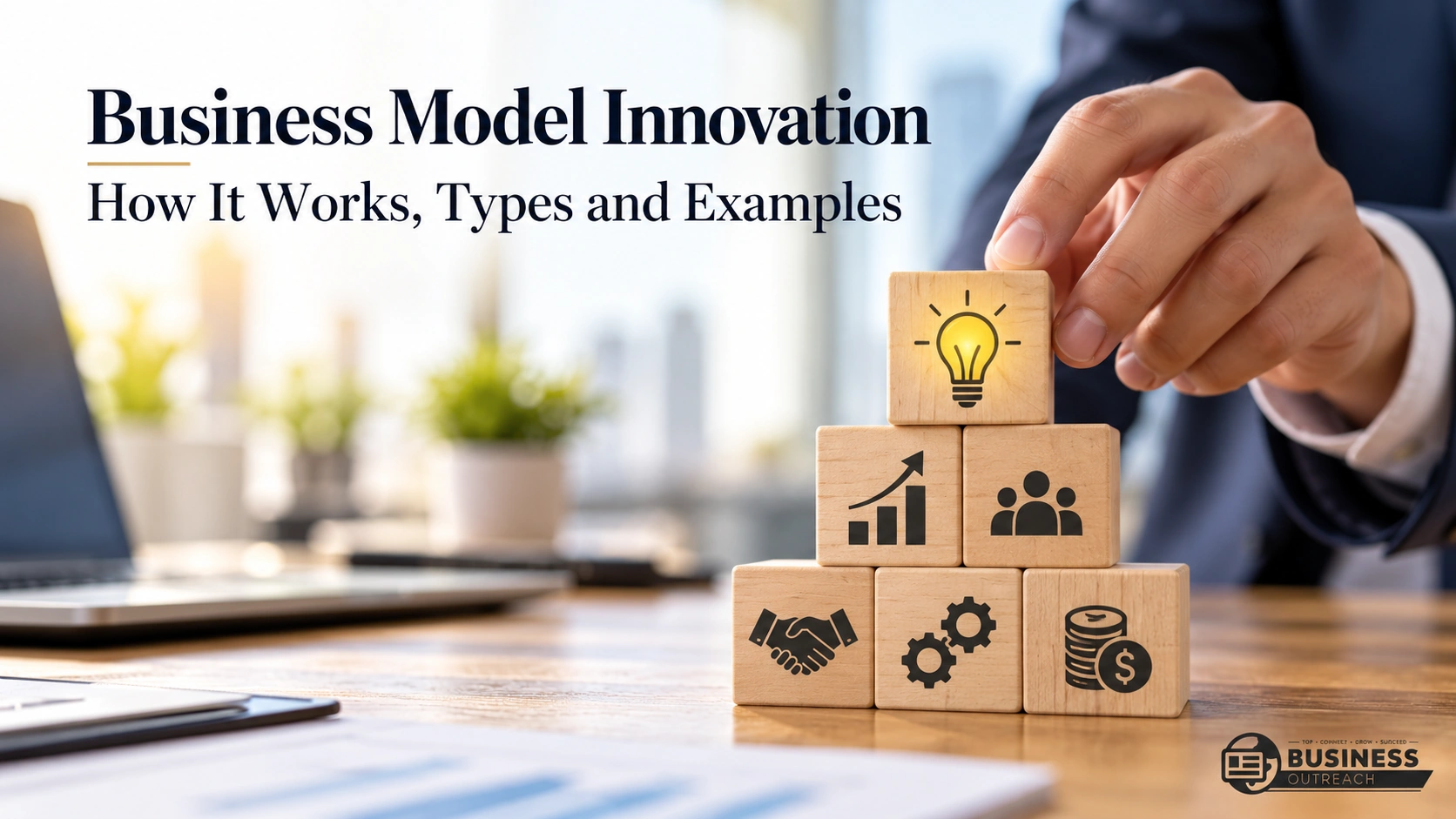
Business Model Innovation: How It Works, Types and Examples
Business model innovation goes beyond improving a product or launching a new marketing campaign. It involves meaningfully redesigning how a company creates value for customers, delivers that value, or captures economic value in return. A business may change who it serves, how customers buy, how it generates revenue, which partners it involves, or how it organizes operations. Because these elements are connected, successful redesign usually requires testing assumptions before committing to large-scale change.
Business model innovation means redesigning how a company creates, delivers, or captures value. It can affect customers, channels, pricing, revenue, resources, activities, partnerships, and costs. Effective innovation requires more than a new idea: businesses must identify assumptions, test them with evidence, understand the operational consequences, and determine whether the new model can work economically.
What Is Business Model Innovation?
Business model innovation is a meaningful change to the logic that explains how a business serves customers and sustains itself economically. The change may affect one important component or reshape several connected parts of the organization.
Create Value → Deliver Value → Capture Value.
Value creation covers resources, activities, technology, and partners. Value delivery involves customers, channels, and relationships. Value capture concerns pricing, revenue streams, and the cost structure needed to support the model.
Not every business change qualifies as innovation. Improving an existing process may strengthen the current model without changing how the business fundamentally works.
How Does Business Model Innovation Work?
The process usually begins with a problem, opportunity, or market shift. A company first needs to understand its current model before deciding what should change.
Current Model → Trigger → Alternative Model → Assumptions → Test → Evidence → Decision
If a company changes one part of the model, it should examine the consequences elsewhere. For example, moving from one-time software licenses to recurring subscriptions may also affect billing, customer support, product updates, retention, sales incentives, and cash flow. Business model innovation is therefore better understood as system redesign rather than an isolated change.
Why Do Businesses Innovate Their Models?
Companies may explore alternative models when customer expectations shift, technology changes how products can be delivered, margins weaken, new competitors appear, or distribution economics change. Other triggers include new customer segments, regulatory changes, new partnerships, cost pressure, and changing market behavior. A trigger does not automatically mean the entire model should be replaced. Poor sales execution, weak onboarding, or inefficient operations may require better execution rather than a new business model.
Business Model Innovation vs Product Innovation
Product innovation and business model innovation can happen together, but they focus on different things.
| Factor | Product Innovation | Business Model Innovation |
| Main Focus | Product or service | Business logic |
| Core Question | What are we offering? | How do we create, deliver, and capture value? |
| Typical Change | Features, design, performance | Customers, channels, revenue, operations |
| Scope | Often narrower | Can affect several components |
| Example | New software feature | License sales shifting to subscriptions |
Adding a new software feature is primarily product innovation. Moving to subscriptions while redesigning billing, support, customer relationships, and delivery is a broader business-model change.
Business Model Innovation vs Business Model Improvement
Improvement strengthens an existing model. Innovation changes important parts of how the model works. Reducing delivery time, improving conversion rates, or automating an established process may be operational improvements. Moving from distributor-led sales to direct digital sales with new fulfillment, pricing, and customer-service requirements could represent business model innovation. No universal threshold separates every improvement from innovation, so the change’s significance and interconnected effects matter.
Main Types of Business Model Innovation
Several broad forms are useful for understanding how innovation can occur.
New Business Model Creation
A company or startup develops a new way to serve customers, deliver value, and generate revenue rather than relying on an established model.
Business Model Transformation
An existing company substantially redesigns how it operates. Customers, channels, revenue streams, capabilities, and costs may all change.
Business Model Diversification
A company keeps its existing model while introducing another. For example, a company may continue traditional sales while testing a new subscription offer.
Partial Business Model Redesign
Selected elements such as pricing, channels, customer relationships, partnerships, or revenue streams change materially without replacing the entire model. These categories are useful guides rather than a single universal taxonomy.
What Parts of a Business Model Can Be Innovated?
The business model canvas provides a useful way to identify where changes might occur. Changing one block often affects others. A new customer segment may require different channels, pricing, support, resources, and costs.
How to Innovate a Business Model
Start by documenting how the existing business creates, delivers, and captures value. Then identify where customer relevance, economics, or execution is weakening. Next, generate alternatives rather than committing immediately to the first idea. Consider different customers, channels, pricing mechanisms, partnerships, or delivery structures.
Before implementation, identify assumptions that combine high impact with low evidence. Those deserve testing first. Small pilots, prototypes, limited customer offers, or controlled experiments can provide evidence before the organization invests heavily.
Scale → Revise → Retest → Stop
Stopping a weak experiment can help if the company learns why the model didn’t work.
How to Generate Alternative Models
Useful questions include:
- What if a different customer paid?
- What if access replaced ownership?
- What if usage replaced fixed pricing?
- What if customers bought directly?
- What if a partner handled part of delivery?
- What if an ongoing relationship replaced a one-time sale?
- What if an existing resource served another market?
These prompts are not solutions by themselves. Their purpose is to challenge assumptions that the current model treats as fixed.
How to Test Business Model Innovation
A proposed model should be treated as a hypothesis until evidence supports it.
Assumption → Test → Evidence → Learning → Decision
Evidence can come from customer interviews, prototypes, paid pilots, purchases, usage behavior, pricing tests, renewals, partner performance, and operating-cost data. Not all evidence is equally strong. A customer saying an idea sounds useful is weaker than that customer paying for it and continuing to use it.
High Impact + Low Evidence = Test First
This helps teams focus on questions most capable of breaking the model.
Examples of Business Model Innovation
Business model innovation becomes easier to understand when the mechanism of change is clear.
One-Time Sale to Subscription
A company shifts from one-time payments to an ongoing customer relationship. This can affect revenue timing, billing, product updates, support, retention, and customer success. A subscription business model can increase recurring revenue visibility, but it also makes churn and ongoing value more important.
Ownership to Usage-Based Access
Customers pay according to usage instead of buying an asset outright. This may lower initial commitment, but it can create more variable bills and revenue. Accurate usage tracking, billing, and ongoing service delivery also become important.
Distributor to Direct-to-Customer
A company sells directly rather than relying mainly on intermediaries. Direct selling may increase access to customer data and relationships, but it can also create new marketing, fulfillment, technology, and support responsibilities. Existing distributors may also view the new channel as competition.
Product Sale to Product-as-a-Service
Instead of selling an asset once, a company provides ongoing access, maintenance, or service outcomes. The shift may create longer customer relationships, but it can also require new monitoring, support, billing, service operations, and asset-management capabilities.
Revenue, Channel and Operating Model Innovation
Revenue-model innovation can include shifts such as:
- one-time sale → subscription
- fixed fee → usage-based pricing
- direct sale → commission
- ownership → access
- product → service
A pricing change alone is not always full business model innovation. The case becomes stronger when the change also affects customer relationships, delivery, technology, activities, or costs. The same principle applies to channels. Moving from retail to direct digital sales may alter customer acquisition, fulfillment, data access, support, and partner relationships.
Operational redesign can involve outsourcing activities, using shared infrastructure, building platform partnerships, or relying on external technology providers. These approaches may reduce some internal requirements while increasing dependence on partners.
Benefits of Business Model Innovation
Business model innovation may help a company:
- reach new customer segments
- create additional revenue mechanisms
- improve alignment with customer needs
- lower some delivery costs
- create differentiation
- make greater use of partnerships
- improve scalability
- respond to structural market changes
These are potential benefits, not guaranteed results. A strategically interesting model can still fail because customers reject it or the organization cannot execute it efficiently.
Risks and Challenges
Redesigning a business model can introduce substantial uncertainty. Common risks include customer resistance, implementation costs, channel conflict, cannibalization, pricing uncertainty, partner dependency, internal resistance, and operational complexity.
Cannibalization matters most for established companies. A new offer may attract existing customers away from a profitable old model rather than creating entirely new revenue. A creative model is not enough if the economics or organizational capabilities do not support it.
How to Evaluate a New Business Model
A practical evaluation framework is:
Desirability → Feasibility → Viability → Evidence
| Area | Key Question |
| Desirability | Do customers actually want it? |
| Feasibility | Can the organization deliver it? |
| Viability | Can revenue and costs work together? |
| Evidence | What supports those assumptions? |
A model can be attractive to customers but operationally difficult. It can also be technically feasible but economically weak. Evaluation should therefore consider customer demand, capabilities, revenue, costs, partner requirements, and evidence together.
Common Business Model Innovation Mistakes
A common mistake is redesigning the model before understanding the customer problem. Another is copying competitors without checking whether the same economics, capabilities, or customer behavior apply.
Businesses can also focus too heavily on pricing while ignoring operations and customer relationships. Testing too many changes at once makes it harder to understand what caused the result.
Other mistakes include scaling before validation, assuming positive feedback equals demand, ignoring channel conflict, underestimating implementation costs, and calling every efficiency improvement innovation.
When Should a Business Consider Business Model Innovation?
A deeper redesign may be worth exploring when customer needs change materially, the current revenue logic weakens, new technology enables different delivery methods, distribution economics shift, or new customer groups become attractive. Before redesigning everything, however, ask:
Is the business model weak, or is execution weak?
Poor marketing, weak sales management, confusing onboarding, or inefficient processes may be fixable without replacing the underlying model.
FAQs
What is business model innovation?
Business model innovation is the meaningful redesign of how a company creates, delivers, or captures value. It can involve customers, channels, revenue, pricing, resources, activities, partnerships, or costs.
What is an example of business model innovation?
Moving from one-time product sales to subscriptions can be an example when the change also affects billing, support, customer relationships, delivery, and revenue logic.
What is the difference between business model innovation and product innovation?
Product innovation changes the product or service itself. Business model innovation changes the broader logic through which a business creates, delivers, and captures value. Both can occur together.
What are the main types of business model innovation?
Useful categories include creating a new model, transforming an existing model, adding another model alongside the current one, or materially redesigning selected business-model components.
Can a business innovate its model without changing its product?
Yes. A business can innovate its model by changing pricing, distribution channels, customer relationships, or revenue streams without modifying the product itself. The change must meaningfully affect how the business creates, delivers, or captures value.
What are the main risks of business model innovation?
Risks include uncertain demand, implementation costs, channel conflict, cannibalization, pricing problems, operational complexity, partner dependency, and scaling before sufficient evidence exists.
Final Thoughts
Business model innovation is not simply about introducing a new product or changing a price. It involves redesigning how a business creates, delivers, or captures value and then testing whether that new logic is desirable for customers, feasible to operate, and economically viable before scaling.