
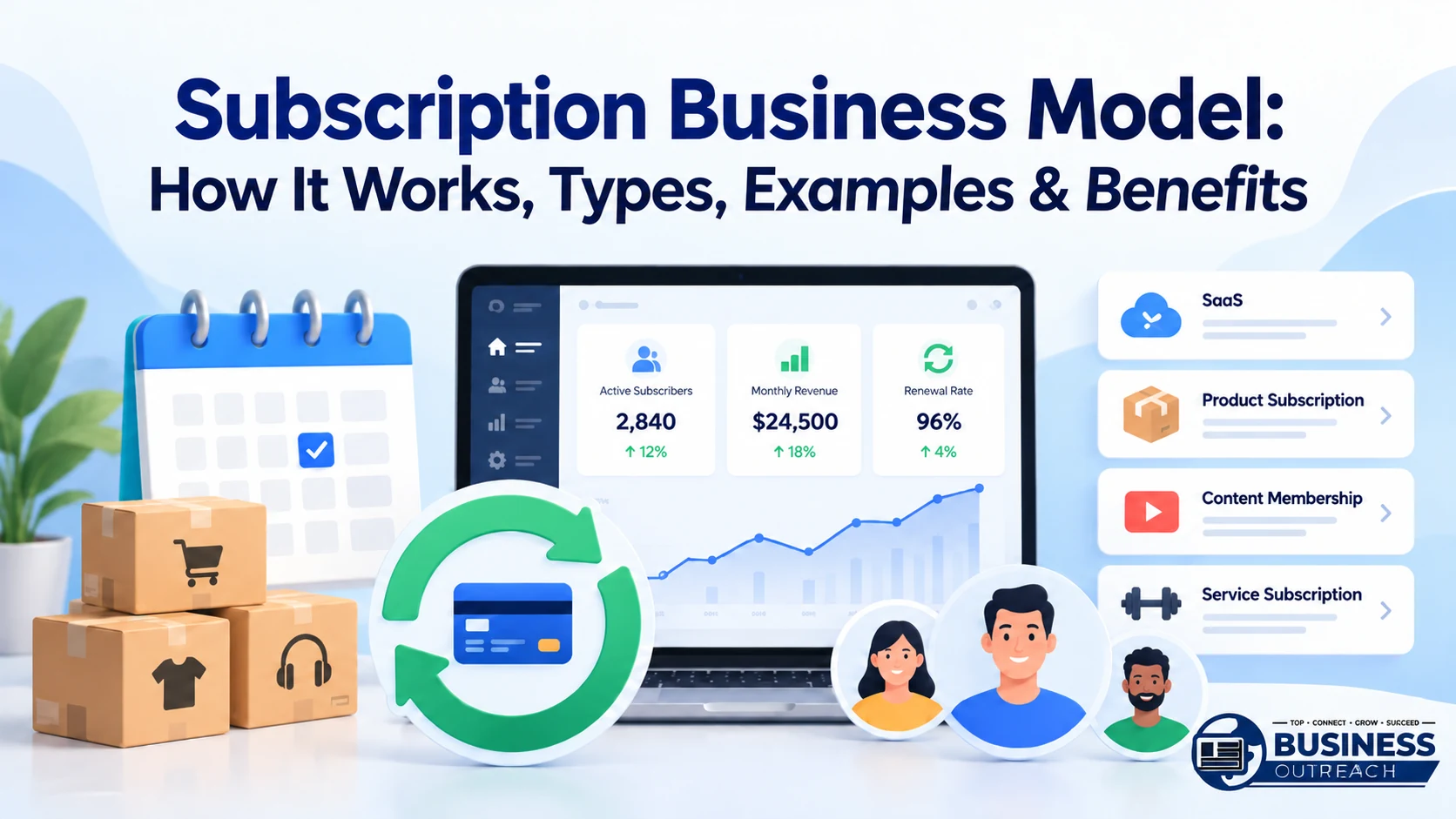
Subscription Business Model: How It Works, Types, Examples & Benefits
A subscription business model allows customers to pay regularly for continued access to a product, service, membership, platform, or recurring delivery. Instead of depending entirely on one-time purchases, the business builds an ongoing customer relationship and must keep providing enough value to justify renewal. This approach is common in software, media, ecommerce, education, memberships, fitness, and professional services because recurring payments can create more consistent revenue patterns when customers remain satisfied.
A subscription business model generates revenue through recurring customer payments rather than relying only on one-time sales. Businesses may charge monthly, annually, by usage, or through different pricing tiers. The model can improve revenue visibility and customer relationships, but long-term performance depends on retention, pricing, customer value, and effective churn management.
What Is a Subscription Business Model?
A subscription business model is a commercial structure in which customers make recurring payments in exchange for continued access to a product, service, platform, membership, or recurring delivery. Billing may happen monthly, quarterly, annually, or according to another agreed schedule.
The main difference from a traditional sale is the length of the customer relationship. In a one-time transaction, the customer pays once and receives the product or service. In a subscription arrangement, the business continues serving the customer after the initial purchase.
That changes how the company operates. Winning the first sale is only one part of the process. The business also needs to maintain service quality, improve the customer experience, handle renewals, reduce avoidable cancellations, and keep the subscription useful.
This structure can work for both digital and physical businesses. Software companies may charge for continued platform access, while ecommerce businesses may deliver products automatically. Membership businesses may use recurring fees for access to benefits, communities, resources, or services.
How Does a Subscription Business Model Work?
A subscription business usually begins with a recurring customer need. The company then creates an offer designed to solve that need continuously rather than through a single transaction.
Customers select a plan, provide payment details, and receive access for a defined billing period. Depending on the terms, the subscription may renew automatically unless the customer cancels, pauses, or changes the plan.
The business earns revenue while continuing to provide access, support, updates, deliveries, content, or other benefits. Customers may also upgrade, downgrade, add users, change usage levels, or move between monthly and annual billing.
This creates an operating model where acquisition and retention both matter. New subscribers can increase revenue, but high cancellation rates may offset that growth. Subscription businesses therefore need to understand not only how many customers they gain, but also how long those customers stay.
Common Types of Subscription Business Models
Fixed Subscription Model
A fixed subscription charges the same recurring fee for a defined product or service. Pricing and benefits are easy to understand because every customer on that plan pays the same amount. This works well when customers receive similar value and extensive customization is not required.
Tiered Subscription Model
Tiered pricing offers several plans at different price points. Each level typically includes a different set of features, usage limits, service levels, or support options.
This structure allows one business to serve customers with different needs. A basic plan may suit individuals, while higher tiers can target teams or larger organizations.
Usage-Based Subscription Model
Usage-based pricing connects charges to how much a customer uses a service. Fees may depend on transactions, storage, API requests, seats, data volume, or another measurable unit. This can give customers greater flexibility, although monthly revenue may vary more than it does under a fixed subscription.
Freemium Subscription Model
A freemium model provides basic access at no cost and charges customers who want advanced features, higher limits, or additional functionality. The business relies on converting a portion of free users into paying subscribers by offering enough premium value to justify the upgrade.
Membership Model
Membership businesses charge recurring fees for benefits such as exclusive access, resources, communities, services, discounts, or special experiences. Memberships overlap with subscriptions, but they often place greater emphasis on belonging, privileges, or access to a defined group.
Product and Replenishment Subscriptions
Physical-product businesses can use subscriptions to deliver frequently needed products on a regular schedule. Examples include household goods, food products, personal-care items, or other consumables. The main customer benefit is often convenience, since the buyer does not need to remember to place the same order repeatedly.
Subscription Business Model Examples
Subscription models appear across many industries because the basic structure can be adapted to different types of recurring value. Common subscription business model examples include SaaS platforms, streaming services, membership programs, subscription boxes, and online learning platforms that provide ongoing value through recurring payments.
| Business Type | Customer Value | Common Billing Style |
| SaaS software | Continued platform access | Monthly or annual |
| Streaming services | Ongoing content access | Monthly |
| Membership businesses | Benefits or exclusive access | Monthly or annual |
| Subscription boxes | Curated recurring products | Monthly |
| Replenishment services | Regular delivery of essentials | Recurring schedule |
| Online learning | Continued access to courses or resources | Monthly or annual |
A SaaS company may charge for continued use of its software. A subscription box business might deliver a collection of products each month. An education platform can provide ongoing access to courses, lessons, or learning resources. The details vary, but the commercial logic remains similar: the customer continues paying because the business continues providing something useful.
How Subscription Businesses Make Money
The primary revenue source is usually the recurring subscription fee. However, many businesses create additional revenue through pricing tiers, upgrades, higher usage, add-ons, extra users, or premium features.
For example, a software customer may begin on a basic plan and later add more users or upgrade to a plan with advanced features. A product-subscription customer might increase delivery frequency or choose a larger package.
Monthly and annual billing can also affect revenue timing. Monthly plans usually require a smaller upfront commitment, while annual plans may bring more cash into the business earlier in the customer relationship. Recurring payments can make future revenue easier to estimate, but forecasts depend on customer behavior. Cancellations, downgrades, failed payments, and reduced usage can all change expected revenue.
Benefits of a Subscription Business Model
One important benefit is improved revenue visibility. When a company has an established base of active subscribers, it can often estimate upcoming revenue more clearly than a business that relies only on new one-time purchases.
Subscription models can also create longer customer relationships. Because the interaction continues beyond the first sale, businesses gain more opportunities to understand customer behavior, collect feedback, improve the service, and respond to changing needs. Convenience can also benefit customers. Automatic access, scheduled delivery, and recurring billing can remove the need to make the same purchase repeatedly.
The model may also create opportunities for expansion. Customers who receive more value over time may upgrade, increase usage, add users, or choose premium features. These advantages are not automatic. They depend on the business consistently delivering enough value for customers to remain subscribed.
Challenges and Disadvantages
Churn is one of the most important challenges. Churn occurs when customers cancel or stop paying. A company may continue acquiring new subscribers and still struggle if existing customers leave at a high rate.
Customer acquisition can also be expensive. Advertising, sales, content, onboarding, promotions, and other acquisition activities may require significant spending before a customer generates enough revenue to cover those costs.
Subscription fatigue creates another challenge. Customers may already pay for numerous digital services, memberships, and recurring deliveries, making them more selective about adding new subscriptions. Billing problems can also interrupt revenue. Expired cards, payment failures, and outdated billing information may cause involuntary cancellations even when the customer still wants the service.
Perhaps the biggest operational challenge is that the company must keep justifying the recurring charge. A one-time product mainly needs to deliver value around the purchase, while a subscription must repeatedly give customers a reason to stay.
Key Subscription Business Metrics
Subscription businesses use several metrics to understand recurring revenue, customer retention, and acquisition economics.
| Metric | What It Measures |
| MRR | Monthly recurring revenue |
| ARR | Annualized recurring revenue |
| Churn Rate | Customers lost during a period |
| Retention Rate | Customers who remain |
| CAC | Cost of acquiring a customer |
| CLV/LTV | Estimated customer value over time |
Monthly Recurring Revenue (MRR) represents recurring subscription revenue associated with a month. It is particularly useful for businesses that sell monthly plans or convert longer contracts into monthly equivalents.
Annual Recurring Revenue (ARR) expresses recurring revenue on an annual basis. A simplified calculation may use MRR multiplied by 12 when monthly recurring revenue is relatively stable. Churn rate measures how many customers leave during a specific period. High churn can weaken growth even if customer acquisition appears strong. Retention rate looks at the opposite side of the relationship by measuring how many customers remain with the business.
Customer Acquisition Cost (CAC) estimates how much the company spends to acquire a new customer, while Customer Lifetime Value (CLV or LTV) estimates the economic value that customer may generate over the relationship. No single metric tells the full story. Subscription businesses usually need to examine revenue, churn, retention, acquisition costs, and customer value together.
How to Build a Subscription Business Model
The first step is identifying a customer need that occurs repeatedly. A strong subscription solves an ongoing problem instead of simply adding recurring billing to something customers only need once.
Next, define what customers will continue receiving. That value might come from software access, regular product delivery, ongoing support, fresh content, updates, convenience, education, or membership benefits.
Choose a pricing structure that matches how customers receive value. A fixed plan may work for a standardized service, while tiers can serve users with different needs. Usage-based pricing may be more suitable when consumption varies significantly.
Pricing must also support the economics of the business. A low monthly fee may attract interest, but it can become unsustainable if customer acquisition, delivery, support, and operating costs are too high.
The onboarding experience should help new customers reach value quickly. Clear setup, instructions, support, and expectations can reduce confusion during the earliest stage of the relationship.
Finally, monitor customer behavior. Track cancellations, failed payments, support issues, usage patterns, upgrades, downgrades, and customer feedback. These signals can help explain why subscribers stay, leave, or change their plans.
Is a Subscription Business Model Right for Your Business?
A subscription approach usually makes more sense when customers have a recurring need and the business can continue solving that need over time.
It can work well for software, education, content, ongoing services, memberships, maintenance, recurring product delivery, and other offers where continued access or repeat use is genuinely useful.
The model may be less suitable when customers naturally make infrequent or one-time purchases. Forcing recurring payments onto a product that does not provide recurring value can create frustration instead of loyalty.
Businesses also need to evaluate whether the economics are sustainable. Subscription revenue must ultimately support service delivery, customer support, payment processing, acquisition, and other operating costs.
The most important question is therefore not whether recurring billing can be added. It is whether customers have a genuine reason to continue paying.
FAQs
What is a subscription business model?
A subscription business model charges customers recurring fees for continued access to a product, service, platform, membership, or regular delivery. Revenue is generated over an ongoing customer relationship rather than through one transaction alone.
How does a subscription business model make money?
Subscription businesses primarily earn through recurring fees. Additional revenue can come from higher pricing tiers, upgrades, additional users, increased usage, premium features, or optional add-ons.
What are the main types of subscription models?
Common models include fixed subscriptions, tiered pricing, usage-based subscriptions, freemium models, memberships, SaaS subscriptions, replenishment services, and curated subscription boxes.
What is the difference between a subscription and membership model?
A subscription usually provides recurring access to a product or service. A membership may also include community access, privileges, exclusive resources, discounts, or other benefits connected to belonging.
What is churn in a subscription business?
Churn refers to customers who cancel or leave during a defined period. High churn can reduce recurring revenue and make growth difficult even when the business continues attracting new subscribers.
Is a subscription model suitable for small businesses?
It can be, particularly when a small business provides recurring services, memberships, products, maintenance, education, or ongoing access. The model should still be evaluated based on customer demand, retention, pricing, and service costs.
Final Thoughts
A subscription business model can support recurring revenue and longer customer relationships, but recurring billing alone is not enough. The strongest models pair regular payments with clear ongoing value, sustainable pricing, and a customer experience that gives subscribers a reason to stay.




One Comment