Types of Sales Promotion: Categories, Tools, and Examples
A discount coupon, a retailer allowance, and a sales team bonus can all support sales. However, they target different people and solve different problems. Understanding these differences helps you organise promotional activities before choosing an offer. A bakery encouraging afternoon visits needs a different approach from a manufacturer seeking supermarket shelf space. The useful starting point is the audience. Once you know whose behaviour you want to influence, the available methods become easier to compare.
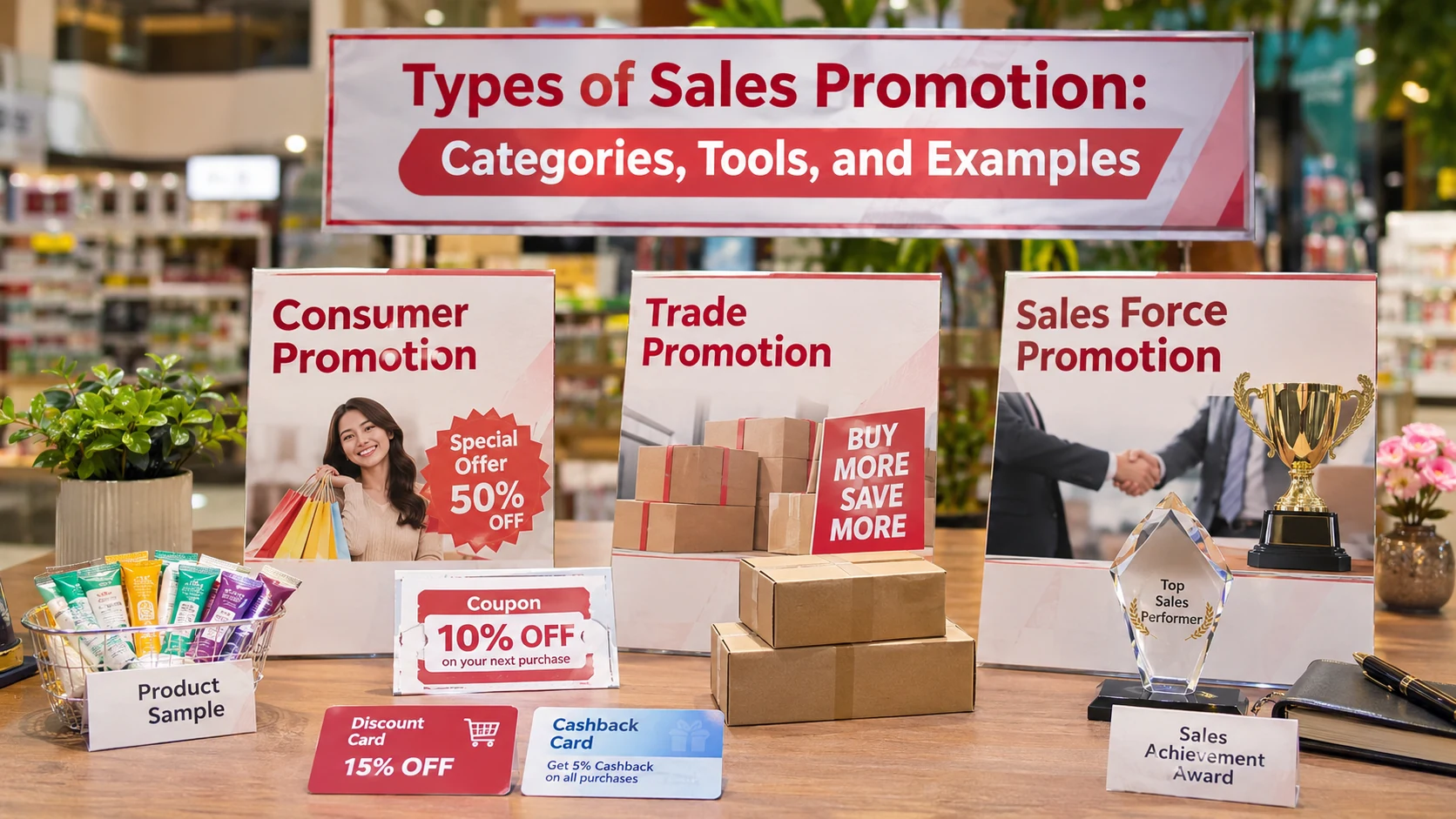
The main types of sales promotion are consumer promotions and trade promotions, with sales force promotions often discussed separately. Consumer offers target end buyers, trade incentives target distribution partners, and sales force incentives target employees. Coupons, samples, rebates, and allowances are techniques used within these categories.
What Are the Main Types of Sales Promotion?
Promotions can be classified by their intended audience. This prevents a common mix-up: treating a coupon and a trade promotion as equivalent categories. One describes a method. The other describes its audience. OpenStax’s Principles of Marketing distinguishes consumer-oriented and trade-oriented promotions. Other marketing frameworks discuss incentives for an organisation’s sales force separately.
Consider a skincare manufacturer introducing a cleanser. It might distribute samples to shoppers, offer retailers an introductory stocking allowance, and reward its employees for qualified account activations. Each activity supports the launch through a different audience. I’d identify the recipient before naming the technique. That simple check makes classification clearer, especially when one campaign includes several connected offers.
Consumer Sales Promotion
Consumer promotions give end customers an additional reason to purchase, try a product, or return. They can reduce the initial cost, provide extra value, or make an unfamiliar product easier to evaluate.
A Manchester bakery offering a weekday coffee-and-pastry deal targets the person consuming the products. The promotion belongs in this category regardless of whether customers discover it through email, social media, or a window sign.
Coupons and Price Discounts
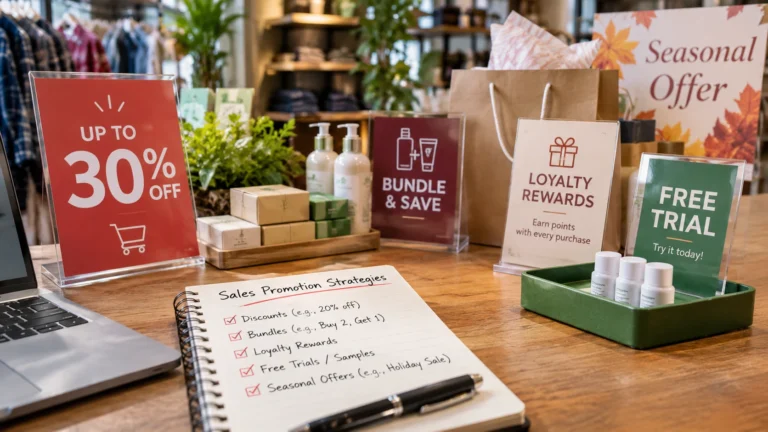
Coupons provide a specified saving when customers meet the offer’s conditions. Price discounts reduce the selling price directly, sometimes without requiring a code. An online stationery retailer might offer £5 off eligible orders above £40. The spending threshold, exclusions, and expiry date should be clear. Check the margin first. Additional orders don’t automatically compensate for the saving given to customers who would have purchased anyway.
Product Samples and Free Trials
Samples let people evaluate a small quantity before buying. Trials provide temporary access to a product or service. A tea company could include a sample sachet with selected orders. A scheduling software provider might offer temporary access to specified features. The conditions matter. Customers should understand what happens when access ends.
Rebates and Cashback Offers
Rebates typically require customers to claim money after an eligible purchase. Cashback arrangements vary, but they also return part of the purchase amount. For example, an appliance manufacturer might offer a payment after customers submit valid purchase details. Explain qualifying models, deadlines, and evidence requirements clearly.
Gifts, Bundles, and Buy-One-Get-One Offers
These methods add value through another item or a combined purchase. A running shop could include socks with selected shoes. A grocery retailer might offer two eligible products for one price. Relevance matters here. An unwanted gift creates little value, while an unsuitable bundle can make purchasing harder.
Loyalty Rewards and Promotional Competitions
A temporary double-points offer can encourage purchases within an existing loyalty programme. The ongoing programme itself is broader than a short promotional campaign. Competitions can also support participation, but their requirements depend on location and format. A UK retailer planning a prize draw should check applicable rules before launch.
Trade Sales Promotion
Trade promotions target intermediaries such as retailers, wholesalers, distributors, and dealers. Their purpose may be to encourage stocking, improve displays, support local advertising, or help introduce a product.
Imagine a US beverage manufacturer approaching independent grocery stores. Consumers cannot purchase its new drink locally unless stores first carry it. An introductory allowance could help encourage that initial stocking decision. The recipient distinguishes the category. A retailer receiving support from a manufacturer is different from a shopper receiving a coupon, even when both activities support the same launch.
Trade Allowances and Introductory Stock Offers
A supplier may temporarily reduce the amount an intermediary pays for qualifying stock. For example, a cereal manufacturer could offer an agreed allowance on a retailer’s first order. Conditions should specify eligible products, quantities, timing, and payment arrangements. Initial orders aren’t enough. Subsequent sales and reorders help assess whether distribution is sustainable.
Display and Cooperative Advertising Allowances
Display support compensates or assists retailers for agreed product presentation. Cooperative advertising arrangements share eligible advertising costs under defined conditions. A gardening supplier might contribute to a retailer’s seasonal leaflet featuring its products. Both parties need clear requirements for placement, timing, evidence, and reimbursement.
Dealer Incentives and Trade Show Offers
Dealers may receive incentives linked to specified sales or stocking activity. Trade shows provide another setting for business promotions. The event is a channel for contact; a temporary introductory order allowance is the incentive. That distinction keeps the explanation precise.
Sales Force Promotion
Sales force promotions target a business’s own sales employees. They encourage defined activities or outcomes through temporary incentives. A software company focused on high ticket sales, for example, might reward account executives for new customers who complete onboarding within an agreed period. That structure considers an outcome beyond obtaining a signature. Some frameworks group business-oriented incentives differently. Here, internal staff incentives remain separate from offers made to independent retailers or distributors.
Sales Contests and Target-Based Bonuses
Contests reward employees according to stated performance criteria. Temporary bonuses provide an additional payment for meeting a defined objective. Targets need care. A contest based only on contract volume may overlook cancellations or unsuitable selling. I’d include relevant quality measures rather than judging success entirely through immediate sales.
Product Launch Incentives
A manufacturer might offer a temporary reward for qualified sales of a new product range. Staff still need product knowledge. An incentive cannot replace accurate information about suitability, limitations, and customer needs.
Consumer Promotion vs Trade Promotion vs Sales Force Promotion
The categories differ mainly by recipient and intended action. The same product launch can include all three, but each activity needs its own conditions and measures. For a new bottled drink, the manufacturer might encourage shoppers to try it, retailers to stock it, and employees to develop suitable accounts. Combining these activities doesn’t make their objectives interchangeable.
| Category | Target audience | Main objective | Example |
| Consumer | End customers | Encourage trial, purchase, or return visits | A sample with an eligible order |
| Trade | Retailers, wholesalers, distributors, or dealers | Support stocking, visibility, or distribution | An introductory stocking allowance |
| Sales force | The organisation’s sales employees | Encourage defined sales activities or outcomes | A temporary launch bonus |
Ask who receives the benefit. A shopper’s discount belongs to consumer promotion. An allowance paid to the retailer belongs to trade promotion, even if the retailer later reduces its shelf price.
Examples of Sales Promotion
These hypothetical scenarios show how audience, incentive, and objective fit together. They are illustrations, not reported business results. Each example also needs a different measure. A bakery would examine qualifying purchases and costs. A manufacturer would check retailer orders and subsequent demand. A software business would assess whether newly acquired customers activate successfully.
A UK Bakery Encourages Afternoon Visits
A bakery offers a pastry with selected coffee purchases between 2 p.m. and 4 p.m. on weekdays. This is a consumer promotion. Its objective is to increase demand during quieter hours. The owner checks whether additional contribution covers the pastry cost and whether existing purchases simply shift into the offer period.
A US Manufacturer Introduces a Beverage
A beverage manufacturer provides an introductory allowance on independent stores’ first qualifying orders. This is a trade promotion. It aims to establish initial distribution. Reorders help reveal whether shoppers actually want the drink.
A Software Business Supports Customer Activation
A software provider offers a temporary staff bonus for new accounts that complete specified activation steps. This is a sales force promotion. It connects employee rewards with an observable customer outcome. The business also monitors cancellations and complaints.
How to Choose the Right Promotion Type
Start with the obstacle. Is an end customer hesitant to try the product? Does a retailer lack a reason to stock it? Does your sales team need a clearly defined launch objective? For a new snack brand without local distribution, a consumer coupon alone may achieve little. Retail availability needs attention first.
I’d work through four questions:
- Who needs to act? Identify the recipient before choosing the incentive.
- What action matters? Define trial, stocking, purchase, or another measurable outcome.
- What will it cost? Include discounts, gifts, administration, and fulfilment.
- How will you evaluate it? Match the measure to the objective.
Avoid mixing categories with communication channels. Email can deliver a consumer coupon or announce a dealer offer. It doesn’t determine the category. Also examine what happens afterward. An initial order followed by no reorders may signal weak demand. Higher sales with lower contribution may indicate an expensive offer.
Frequently Asked Questions
What are the three main types of sales promotion?
A common three-part classification includes consumer, trade, and sales force promotions. Some textbooks use two main categories, consumer and trade, while discussing internal sales incentives separately.
Are discounts a type of consumer promotion?
Discounts are a consumer promotion technique when offered to end customers. A temporary price allowance offered to a wholesaler or retailer instead belongs to trade promotion because the recipient differs.
What is the difference between consumer and trade promotion?
Consumer promotion targets end buyers, while trade promotion targets intermediaries such as retailers and distributors. A product sample for a shopper and a stocking allowance for a retailer illustrate the distinction.
Is social media a type of sales promotion?
Social media is a communication channel rather than an audience-based promotion category. A retailer can use it to communicate a coupon, gift offer, or competition, but the underlying incentive determines the method.
How is sales force promotion different from trade promotion?
Sales force promotion targets the organisation’s own sales employees, while trade promotion targets independent channel partners. A staff launch bonus differs from an allowance offered to an external dealer.
Final Thoughts
Understanding the categories makes promotional planning more precise. Identify the audience, define the action, and then compare suitable methods. A sample, stocking allowance, and employee bonus can support the same launch while serving different purposes.
Keep the terms clear and the economics visible. Evaluate purchases, reorders, or customer activation according to the objective. The useful promotion is one that encourages the intended behaviour at a cost the business can justify.