Sales Closing Techniques That Work Without Pressure
A sales conversation can go well and still end without a clear decision. The buyer may understand the offer, agree with the value, and remain unsure about the next step. That is where closing matters. Effective sales closing techniques help you confirm interest, uncover final concerns, and guide the buyer toward a sensible decision without pressure. The right approach depends on timing, trust, deal size, and the buyer’s approval process. A direct close may suit one conversation, while a trial close may work better in another. Strong closing does not rely on clever lines alone. It starts with listening, qualification, and a clear understanding of what the buyer needs.
Sales closing techniques are structured methods used to help a buyer make a clear decision after their needs, concerns, and options have been discussed. Effective closing matches the buyer’s readiness, resolves uncertainty, and confirms the next logical step without manipulation or false urgency.
What Are Sales Closing Techniques?
Sales closing techniques are structured methods that help move a sales conversation toward a clear decision. That decision may involve completing a purchase, signing an agreement, booking another meeting, or confirming a specific next step.
What Is a Sales Close?
A sales close is the point where the buyer decides the offer. In a simple retail purchase, this may mean completing payment.
In complex B2B sales, the close may involve approving a proposal, scheduling a technical review, or moving the opportunity to contract discussion.
How Does a Closing Technique Work?
A closing technique gives a salesperson a clear way to ask for commitment. It may involve summarizing the buyer’s needs, checking their readiness, offering two suitable options, or directly asking whether they want to proceed. To distinguish a good salesperson from a great one, observe how effectively they adapt their closing approach to the buyer’s needs without applying unnecessary pressure.
The technique must fit the conversation. A buyer with unresolved concerns usually needs clarification before commitment.
Sales Closing Technique vs Closing Line
A closing technique is the complete approach used to guide the decision. A closing line is only the question or sentence used at the end.
For example, a summary close reviews the buyer’s agreed priorities before asking for a decision. The final line may be, “Would you like to begin next month?”
Why Timing Matters in Sales Closing
Even a strong closing question can fail when it is asked too early. Before attempting to close, you should understand the buyer’s problem, expected outcome, budget, timeline, and approval process.
A marketing consultant, for example, should clarify campaign goals and reporting needs before requesting a signed agreement.
Ethical Closing vs Pressure Selling
Ethical closing helps the buyer evaluate the offer and choose a suitable next step. It provides accurate information, time to respond, and room to raise concerns.
Pressure selling relies on exaggerated claims, false urgency, hidden conditions, or repeated demands. These tactics can damage trust, even when they produce a quick decision.
What Should Happen Before You Close a Sale?
Closing works best when the earlier parts of the sales process are complete. Asking for commitment before understanding the buyer usually creates resistance.
Confirm the Buyer’s Main Problem
You should know what the buyer wants to solve and why the issue matters now.
A logistics company may not simply need new software. It may need to reduce delivery delays caused by poor route visibility.
Understand the Expected Outcome
Clarify what success looks like for the buyer. This may involve saving time, reducing costs, increasing sales, or improving control.
Without this information, your closing question may focus on the wrong value.
Identify the Decision-Makers
Some buyers can approve the purchase themselves. Others need finance, legal, security, or senior management approval.
In those cases, the next close may be a meeting with another stakeholder rather than a signed contract.
Resolve Important Concerns
Do not ignore objections just because the buyer appears interested. Price, timing, implementation, risk, and internal resources may still affect the decision.
I’d resolve the main concern before asking for final commitment.
How to Know When a Customer Is Ready to Buy
Buyers often show readiness before they clearly say yes. These signals do not guarantee a sale, but they show the conversation may be ready to move forward.
Common Buying Signals
A buyer may be ready when they:
- Ask about pricing or payment terms
- Discuss delivery or implementation dates
- Compare packages or service levels
- Ask what happens after purchase
- Mention another decision-maker
- Request contract or warranty details
- Explain how they would use the solution
A SaaS buyer asking about onboarding, migration, and user permissions is thinking beyond the product demonstration.
Use a Trial Question to Confirm Readiness
Do not rely on assumptions alone. A short trial question can reveal whether the buyer is comfortable.
You might ask, “Does this approach solve the reporting problem you mentioned?”
A positive response shows progress. Hesitation tells you where more discussion is needed.
Best Sales Closing Techniques

No single method works in every situation. The best sales closing techniques depend on the buyer’s confidence, remaining concerns, and required level of commitment.
1. Assumptive Close
The assumptive close treats the next step as likely and asks how it should happen.
“Would Tuesday or Thursday work better for onboarding?”
Use it when the buyer has shown strong interest and key concerns are resolved. It can feel premature when the buyer is still uncertain.
2. Summary Close
The summary close reviews the buyer’s priorities before asking for a decision.
“You need faster follow-up, clearer reporting, and better lead ownership. This plan covers all three. Would you like to start next month?”
This approach works well after a detailed discussion. Keep the summary focused.
3. Trial Close
A trial close checks readiness before requesting final commitment.
“Does this option meet the requirements we discussed?”
It helps you identify uncertainty without forcing a decision. I’d use it when the buyer appears interested but has not clearly committed.
4. Question Close
The question close uncovers the final barrier.
“What would stop you from moving forward?”
“Is there anything important we have not covered?”
Ask one clear question, then pause. The buyer’s answer should guide your next step.
5. Alternative-Choice Close
This technique gives the buyer two suitable options.
“Would the monthly or annual plan fit your needs better?”
Both choices must be realistic. Do not use this method to hide the buyer’s right to decline.
6. Soft Close
A soft close tests interest without demanding an immediate purchase.
“Would it help to review the implementation plan with your operations manager?”
This approach suits buyers who need more confidence, information, or internal support.
7. Need-Based Close
The need-based close connects the buyer’s main problem to the proposed solution.
“You said missed follow-ups are costing qualified leads. This process gives each lead an owner and deadline. Are you comfortable moving forward?”
The value statement should remain accurate and realistic.
8. Direct Close
The direct close clearly asks for a decision.
“Are you ready to move forward?”
It works best when the buyer’s questions have been answered. I’d avoid using it while important objections remain.
9. Next-Step Close
The next-step close confirms a smaller action rather than the entire purchase.
“Can we schedule a technical review with your IT manager next Wednesday?”
This method suits longer B2B deals involving finance, legal, security, or senior management.
10. Urgency Close
The urgency close highlights a genuine time-sensitive reason to decide.
“The implementation team has one opening this month. The next available start date is six weeks later.”
Use this technique only when the deadline is real. Invented scarcity can quickly damage credibility.
Types of Sales Closing Techniques Compared
| Technique | Best situation | Pressure level | Main risk |
| Assumptive close | Buyer shows strong readiness | Medium | Asking too early |
| Summary close | Several benefits are agreed | Low | Repeating too much |
| Trial close | Readiness is uncertain | Low | Receiving a vague answer |
| Question close | A hidden concern may remain | Low | Sounding confrontational |
| Alternative-choice close | Two suitable options exist | Medium | Restricting the buyer unfairly |
| Soft close | Buyer needs more confidence | Low | Allowing unnecessary delay |
| Direct close | Major concerns are resolved | Medium | Sounding abrupt |
| Urgency close | A genuine deadline exists | High | Damaging trust |
No technique is universally best. A confident buyer may appreciate a direct question, while a cautious buyer may respond better to a trial or soft close.
How to Close a Sale Without Being Pushy
Closing without pressure requires a clear process. The buyer should understand the offer and feel free to make an informed decision.
Confirm the Need
Briefly restate the buyer’s main problem and expected outcome. This shows that your recommendation is based on their situation.
Address Remaining Questions
Ask whether anything important remains unclear. Do not treat every concern as resistance.
Some objections are reasonable requests for information.
Recommend a Suitable Next Step
The next step should match the buyer’s readiness. It may be a purchase, proposal review, technical meeting, or follow-up call.
Give the Buyer Time to Respond
Once you ask the closing question, stop talking. Filling the silence can create unnecessary pressure or introduce new doubts.
Sales Closing Questions That Move Deals Forward
Good sales closing questions create clarity. They help you understand whether the buyer is ready, uncertain, or waiting for another person.
Questions That Confirm Fit
- “Does this solution meet the priorities we discussed?”
- “Do you feel this approach addresses the main problem?”
- “Is there anything important missing from the proposal?”
Questions That Identify Barriers
- “What would stop you from moving forward?”
- “Which concern still needs to be resolved?”
- “What information would help you make a decision?”
Questions That Confirm the Next Step
- “Who else needs to approve the decision?”
- “Would you like to schedule the technical review?”
- “When would you want implementation to begin?”
- “Can we agree on the next action and date?”
Ask one question at a time. A long list of closing questions can feel like an interrogation.
How to Handle Common Sales Objections
Objections often reveal what the buyer needs before making a decision. They should be explored rather than dismissed.
“It’s Too Expensive”
Do not defend the price immediately. First, determine whether the concern is total cost, budget timing, payment terms, or perceived value.
You might ask, “Which part feels difficult to justify?”
“I Need to Think About It”
Give the buyer room, then clarify what they need to consider.
Ask, “Which part would you like more time to evaluate?”
Agree on a specific follow-up date rather than leaving the conversation open-ended.
“Send Me More Information”
Find out what information would help. A pricing breakdown, implementation plan, case example, or technical document may be more useful than a general brochure.
“We’re Comparing Other Options”
Ask which criteria matter most. Keep the conversation focused on fit, not competitor criticism.
“I Need Approval”
Identify who must approve the purchase, what they need, and when they will review it.
The next close may involve a shared meeting or revised proposal.
Examples of Sales Closing Techniques
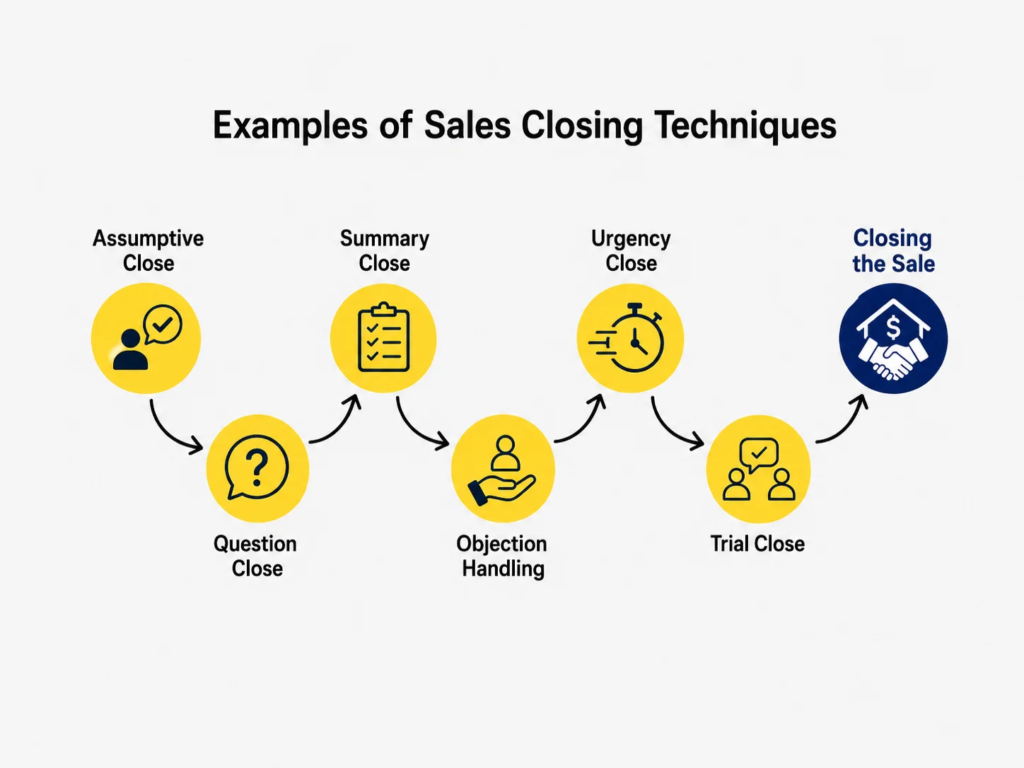
Realistic examples make it easier to understand when each approach fits.
B2B SaaS Account Executive
A buyer likes the platform but worries about migration.
The account executive asks, “If our technical team confirms the migration plan, would you be comfortable moving to contract review?”
This trial close isolates the remaining concern.
Real-Estate Agent
A couple wants to view a property again.
The agent asks whether Saturday morning or Sunday afternoon works better. This alternative-choice close confirms the next action without forcing a purchase.
Marketing Consultant
A client wants more qualified leads and clearer reporting.
The consultant summarizes those needs, confirms the proposed plan covers them, and asks whether the first week of next month suits the launch.
Retail Salesperson
A customer likes a laptop but remains uncertain.
The salesperson offers to compare how two models handle the customer’s design software. This soft close supports the decision instead of rushing it.
Common Sales Closing Mistakes
Small errors near the end of a conversation can weaken an otherwise strong sales process.
Closing Too Early
Interest is not the same as readiness. Confirm the buyer’s needs and concerns before asking for commitment.
Using Fake Urgency
Invented deadlines and false scarcity may produce short-term pressure, but they can damage trust.
Talking After the Buyer Agrees
Once the buyer says yes, confirm the next step. Unnecessary explanation can introduce new doubts.
Ignoring Objections
An unanswered concern does not disappear. It usually returns later in the process.
Giving Too Many Options
Too many plans, packages, or next steps can make the decision harder. Present only the options that fit the buyer’s needs.
Failing to Confirm the Next Action
Every sales conversation should end with a clear action, responsible person, and date.
I’d also avoid treating every objection as an argument to win. The goal is to understand the buyer’s concern and decide whether the offer is a genuine fit.
Frequently Asked Questions
What Is the Most Effective Sales Closing Technique?
The most effective sales closing technique is the one that matches the buyer’s readiness and remaining concerns. A direct close may suit a confident buyer, while a trial close works better when uncertainty remains.
How Do You Know When a Customer Is Ready to Buy?
A customer may be ready when they ask about price, delivery, implementation, contract terms, or next steps. Use a short trial question to confirm readiness instead of relying only on signals.
What Should You Say When Closing a Sale?
Use a clear question such as, “Are you comfortable moving forward?” or “Would you like to confirm the next step?” The wording should match the level of commitment required.
How Do You Close a Sale Without Being Pushy?
Confirm the need, resolve important concerns, recommend a suitable next step, and give the buyer room to respond. Avoid false urgency, repeated pressure, and exaggerated claims.
What Should You Do When a Prospect Needs Time?
Clarify what the prospect needs to consider and agree on a specific follow-up date. This respects their decision process while preventing indefinite delay.
Why Do Salespeople Struggle to Close Deals?
Salespeople often struggle because they close too early, qualify poorly, explain value unclearly, or leave objections unresolved. Better discovery often matters more than a stronger final line.
Final Thoughts
Sales closing techniques work best when they help the buyer make a clear and informed decision. The close should follow strong discovery, relevant value, honest objection handling, and a defined next step. Choose the method according to the buyer’s readiness, not your preferred script. A direct close may fit one conversation, while a trial or next-step close fits another. Strong closing is not about forcing agreement. It makes the decision easier to understand and act on.