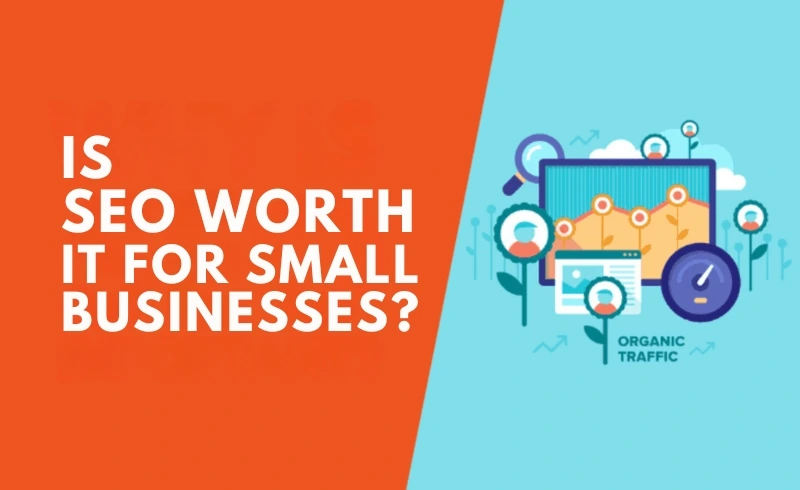
Is SEO Worth It for Small Businesses?
Somebody probably pitched you SEO recently. Maybe an agency emailed, maybe a friend who “knows marketing” brought it up over coffee, and now you’re sitting there wondering: is SEO worth it for small business owners, or is it one of those things that quietly eats money for a year?
Fair question. I’ve spent years doing this work, and I’ll give you the answer nobody selling SEO wants to lead with: it depends on your numbers, your timeline, and your patience. For most small businesses, yes, it pays off, and I can show you the simple math. For some, honestly, it doesn’t. Let’s figure out which one you are.
The Short Answer: Yes, for Most Small Businesses
SEO is worth it for most small businesses because organic search brings in customers at a lower long-term cost than paid ads, though results usually take three to six months to show up. That’s the honest version in one sentence.
The catch sits in that second half. Worth it and instant are two different things, and the businesses that get burned are usually the ones that confuse them. If you can afford to wait a few months for a channel that then keeps producing without you feeding it money every day, SEO belongs in your plan. If you’re still fuzzy on what the work actually involves, I’ve written separately about why SEO is important for small businesses. This piece is about the money side.
What Does SEO Actually Cost a Small Business?
Small businesses typically spend anywhere from a few hundred to a few thousand dollars per month on professional SEO, while doing it yourself costs mostly time. Where you land on that range depends on your market and how much of the work you take on personally.
Doing It Yourself
The DIY route costs you maybe five to ten hours a month once you’ve learned the basics. Claiming your Google Business Profile, fixing page titles, and writing a genuinely useful page now and then. None of it is rocket science. A couple of free or cheap SEO tools for small businesses cover keyword research and rank tracking, and plenty of owners never spend more than that. The real cost is your evenings.
Hiring a Freelancer or Agency
Freelancers in most markets charge somewhere in the low hundreds per month for basic local work, while full-service SEO services for small business sit higher because they bundle strategy, content, and technical work together. Agencies usually start higher still and climb fast in competitive niches.
I’d hedge any exact figure because pricing varies wildly by country and industry, but here’s the rule of thumb I give people: be suspicious of anyone dramatically cheaper than everyone else. A $99-a-month “guaranteed rankings” package is how small businesses end up with spammy links and a penalty. Cheap SEO is usually the most expensive kind.
The Simple Math That Tells You If SEO Is Worth It
Here’s a way to judge this that cuts through every sales pitch: if the lifetime value of one new customer exceeds your monthly SEO cost, even a few extra customers per month makes the investment profitable.
Walk through it with a plumber. Say an average job brings in $300, and a decent chunk of customers call again or refer a neighbor, so one new customer might realistically be worth $600 over a couple of years. If SEO costs $800 a month and eventually brings in five new customers a month, that’s roughly $3,000 of value against $800 of spend. Even if I’m off by half, the math still works.
Now run your own numbers. What’s one customer worth to you, honestly? How many extra customers a month would cover the cost? For most service businesses, the break-even number turns out to be embarrassingly small: two or three customers, sometimes one. That’s why SEO keeps getting recommended despite the slow start.
Why SEO Pays Off Better Than It Looks at First
The part spreadsheets miss is that SEO compounds. A page that ranks doesn’t just deliver customers this month; it delivers them next month too, and the month after, with no extra spend. Compare that with ads, where every customer is bought fresh at full price, forever.
There’s also a quality difference. People arriving from search went looking for you, which is why organic leads tend to close at noticeably higher rates than cold outreach or interruption ads. You’re catching people mid-decision instead of mid-scroll. Stack twelve months of that on top of the compounding, and the channel that looked slow in month two starts looking underpriced in month twelve.
When SEO Is NOT Worth It
This is the section most articles skip, so let me be blunt. SEO is generally not worth it for businesses that need sales within weeks, operate in niches with almost no search demand, or can’t sustain the effort for at least six months.
A few real situations where I’d say skip it, at least for now. Your business has three months of runway and needs revenue immediately: run ads, do outreach, knock on doors. Nobody searches for what you sell because it’s too new or too niche: fix awareness first; search can’t capture demand that doesn’t exist. Or you know yourself well enough to admit you’ll abandon it by week eight: half-done SEO is money down the drain. I’ve actually talked people out of hiring anyone for exactly these reasons, and a couple of them came back a year later when the timing made sense. Nothing wrong with later.
How Long Before You See a Return?
Most small businesses see meaningful movement in three to six months, and a real, obvious return somewhere between six and twelve. Competitive industries stretch longer. Anyone quoting weeks is either lying or planning shortcuts that’ll hurt you eventually.
The expensive mistake isn’t starting SEO; it’s stopping at month two. The early period always feels like nothing’s happening, because visibly, nothing is. Google is quietly recrawling, measuring, and comparing. Owners who bail during that stretch pay for the hard part and walk away right before the payoff, which is a bit like cancelling a gym membership the week your jeans start fitting.
FAQ
Is SEO worth it in 2026?
Yes, arguably more than before. People still search when they need something, whether that’s on Google or through AI tools, and both pull from well-optimized content. The channels are shifting shape, but the underlying habit of searching before buying hasn’t gone anywhere.
How much should a small business spend on SEO?
Spend what you can sustain for six to twelve months without stress, because quitting early wastes everything spent so far; for many small businesses, that’s a DIY-plus-cheap-tools setup at first, moving to a few hundred a month for help once revenue allows it.
Is it better to do SEO yourself or hire someone?
Start yourself if money’s tight and you’ve got a few hours a month; the fundamentals are learnable. Hire when your time is worth more elsewhere, your niche is brutal, or you keep not doing it. The worst option is paying someone cheap and assuming it’s handled.
Is SEO a waste of money for some businesses?
For some, yes. Businesses needing instant revenue, selling something nobody searches for, or unwilling to stick around past month three usually burn the budget. If any of that sounds like you, spend the money on faster channels first and revisit SEO when things stabilize.
Do AI search results make SEO less valuable?
Not really; they change where answers appear, not how they’re chosen. AI Overviews and chatbots cite content that answers questions clearly and specifically, which is what good SEO produces anyway. Businesses publishing genuinely helpful content are the ones getting quoted in those answers.