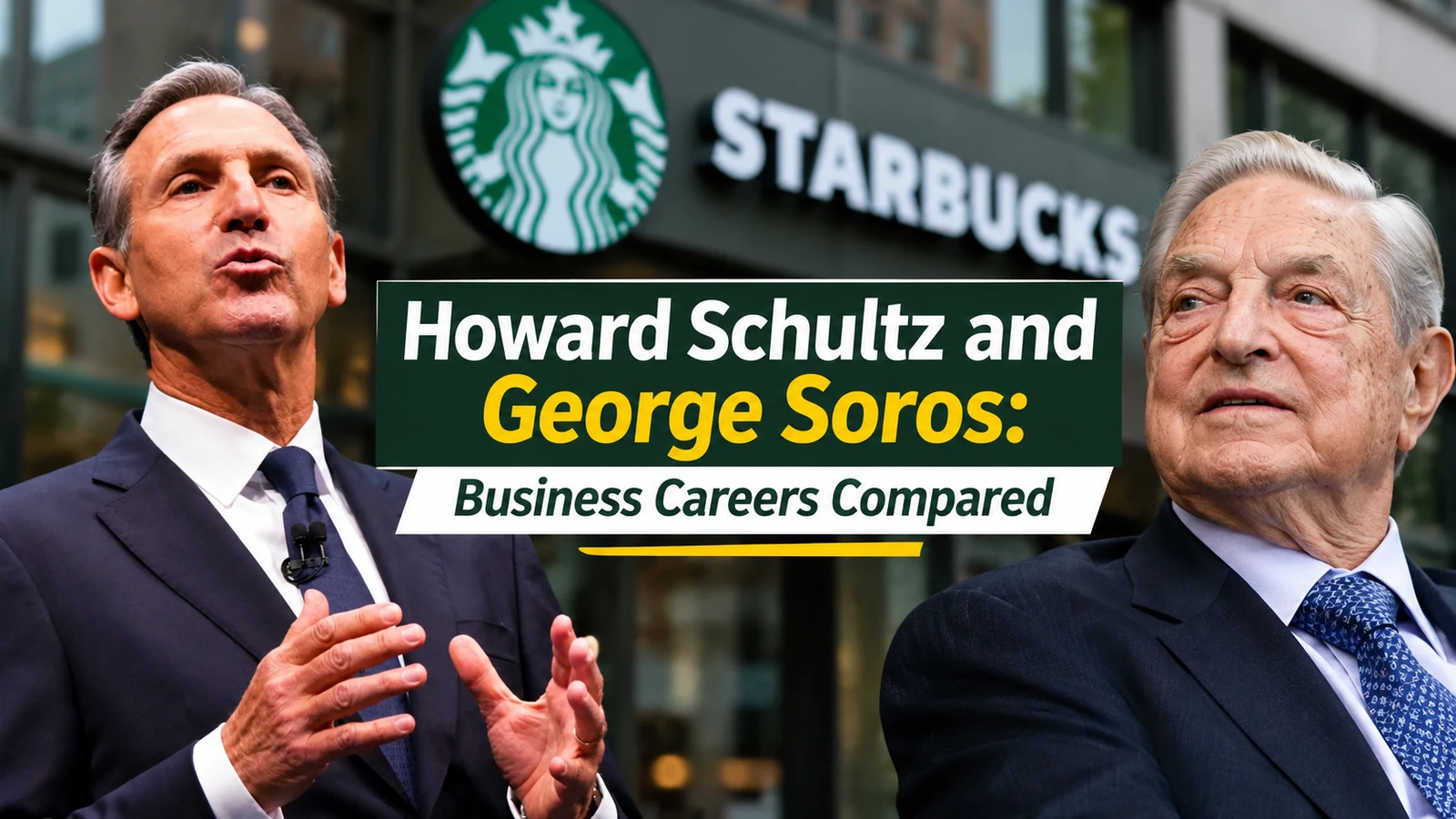
Howard Schultz and George Soros: Business Careers Compared
Howard Schultz and George Soros are associated with two very different kinds of business decisions. Schultz helped turn Starbucks into a coffeehouse chain. Soros built an investment career around managing capital and taking positions in financial markets. Their careers did intersect at the company level. A public filing shows that Soros Fund Management once reported a position in Starbucks shares. Understanding what that filing says helps answer the connection question and sets up a clearer comparison of how each man used capital.
The public records reviewed do not establish a direct business partnership between Howard Schultz and George Soros. Soros Fund Management reported 11,500 Starbucks common shares for the quarter ended June 30, 2010. The filing documents a historical position reported by the firm. It provides no evidence that Schultz and Soros worked together.
Did Howard Schultz and George Soros Work Together?
The clearest business connection in the records reviewed is a historical investment position. In its Form 13F for the quarter ended June 30, 2010, Soros Fund Management LLC listed 11,500 shares of Starbucks common stock. The U.S. Securities and Exchange Commission makes that filing available through its public database.
A Form 13F is a report in which an institutional investment manager discloses certain securities positions. The date on the cover matters because the form describes a reporting period. It gives readers a snapshot of the manager’s reportable positions, with limited information about what happened before or after that date.
I’d read the Starbucks entry at the level the filing supports. The filer was Soros Fund Management LLC, and the security was Starbucks common stock. The entry does not identify George Soros as the person who selected the investment or Howard Schultz as someone involved in the decision. It also gives no basis for claiming that the firm still holds those shares.
That distinction matters because a shared venture would require different evidence. A transaction announcement naming both people, a joint company filing, or a statement describing their respective roles would address whether they worked together. The 2010 filing answers a narrower question about what the investment manager reported.
Howard Schultz and the Growth of Starbucks
Schultz’s business career is best understood through the difference between starting Starbucks and building its coffeehouse business. Starbucks traces its origins to a Seattle store that opened in 1971 and sold coffee beans, tea, and spices. Schultz joined the existing company in 1982. His journey offers a practical example for readers exploring how to become an entrepreneur, particularly the importance of identifying opportunities, developing a business concept, and turning an idea into a scalable operation. The business he later led grew out of a different idea about what customers would come into a coffee shop to do.
From Starbucks Employee to Il Giornale
Starbucks’ company history describes Schultz’s interest in the espresso bars he encountered in Italy. He saw how a coffee counter could become part of a customer’s daily routine. A store selling beans primarily serves people who plan to prepare coffee later. An espresso bar serves people who want a drink at that moment, whether they stay for a conversation or leave with it.
That change affects the whole operation. Selling a bag of beans calls for product knowledge, inventory, and a checkout process. Making espresso drinks to order adds equipment, staff training, and a service workflow. If a café fills up before work, the layout of the counter and the order in which drinks are made can shape the customer’s experience as much as the menu does.
Schultz went on to build Il Giornale, a separate coffeehouse business. Starbucks’ archive records that Schultz and coffee buyer Dave Olsen had opened three Il Giornale locations by the time the original Starbucks owners were ready to sell. Those locations gave the team experience serving customers in the format it wanted to expand.
The Starbucks Acquisition and Coffeehouse Expansion
In 1987, Il Giornale acquired the Starbucks name, roasting plant, and six Seattle stores, according to Starbucks’ historical archive. The combined business adopted the Starbucks name. The acquisition brought the coffeehouse concept together with an established brand, existing locations, and a roasting operation.
I’d separate the decision to acquire those assets from the work of expanding afterward. An acquisition can provide equipment, people, and locations. Expansion still requires decisions about which sites to open, how to train staff, and how to deliver a recognisable experience across stores. Every location also has its own rent, staffing needs, and customer traffic. A café that works near busy offices may need different opening hours or a different layout from one in a residential neighbourhood.
George Soros and His Investment Career
George Soros built his business career in investment management. That work involves deciding how to allocate money across investments and how much exposure to take to any one outcome. A portfolio manager can assess a company, a currency, or a broader market trend. The result depends on how the investment performs and how the manager structures the position.
What Is Soros Fund Management?
Soros Fund Management identifies George Soros as its founder. The firm describes its investment activities as spanning areas such as equities, credit, and macro strategies. Equities are ownership interests in companies, such as common shares. Credit investments involve debt. Macro strategies look at broader economic developments that may affect markets.
A portfolio is a collection of investment positions. Managing it involves choosing what to hold, deciding how large each position should be, and reassessing those decisions as new information comes in. A reported holding in a company’s shares tells you about one position. Running that company would involve a different set of responsibilities, from hiring staff to approving operating budgets.
Soros also founded Open Society Foundations, which describes its work in philanthropic terms. The investment firm and the foundations serve different functions. For this comparison, Soros’s fund management career explains his business role, while the foundations provide context for a separate part of his public work.
How Global Macro Investing Works
Global macro investing looks at developments such as interest rates, exchange rates, and government policy to understand how asset prices might move. For instance, an investor might examine whether a central bank can keep a currency inside a target range when market pressure is pushing it toward the bottom of that range.
A portfolio manager then has to translate that view into a decision. The size of the position matters, as does the cost of keeping it open. Even if the broad assessment proves right, the market can move the other way in the meantime. That makes timing and the ability to absorb losses part of the decision.
Howard Schultz vs. George Soros: Business Roles Compared
Both careers involved capital allocation, which means deciding where to put available money. Schultz’s work at Starbucks shows what that means inside an operating company. Soros’s investment career shows what it means inside a portfolio. The practical difference is what each person can influence once the money is committed.
| Business dimension | Howard Schultz | George Soros |
| Main field | Coffeehouse retail and consumer brand development | Investment and portfolio management |
| Representative decision | Acquire and expand a coffeehouse business | Take a position based on a view of market conditions |
| Where capital goes | Stores, equipment, roasting capacity, and operations | Securities or other financial positions |
| What management can influence | Store format, staffing, service, and location choices | Position size, portfolio exposure, and when to adjust |
| Key uncertainties | Customer demand, operating costs, and execution across stores | Market movements, timing, and changes in policy |
I’d compare what happens after each decision. A retailer that opens a store has to make it work day after day. It can change the menu or train staff, but a lease and equipment make the commitment harder to reverse. A portfolio manager can change a position when market conditions and liquidity allow, but cannot set the exchange rate or determine what policymakers do.
Two Examples of How Their Business Decisions Differed
The Starbucks acquisition and the 1992 British pound position show why the same phrase, putting capital to work, can mean very different things. One decision brought an existing operating business under new ownership. The other exposed an investment portfolio to a possible change in a currency’s value.
Schultz Used an Acquisition to Expand a Retail Concept
The three Il Giornale locations gave Schultz’s team a place to test the coffeehouse format before the Starbucks acquisition. Buying the Starbucks assets offered an established name, six existing stores, and roasting capacity. Building each of those from scratch would have required separate decisions about branding, locations, and supply.
The acquisition still left an operational question. Could the team reproduce the service customers liked at new locations with different staff and different traffic patterns? The opportunity came from expanding the format. The challenge was making that format work beyond the original stores.
Soros Took a Position on the British Pound
The Bank of England’s historical timeline explains that the European Exchange Rate Mechanism required participating currencies to stay within agreed ranges. On September 16, 1992, the UK suspended sterling’s membership in the mechanism, an event known as Black Wednesday. A PBS interview with Soros discusses his investment position based on an expected fall in the pound.
The investment decision and the UK policy decision belong to different actors. Soros could take a position based on his assessment of the pressure on sterling. UK authorities made the decision about the exchange rate arrangement. The example shows how a fund can position itself for a possible policy change while leaving the outcome in the hands of the market and policymakers.
Frequently Asked Questions
Was there a documented business partnership between Howard Schultz and George Soros?
The public records reviewed do not establish a direct business partnership. The specific business connection documented here is that Soros Fund Management reported a Starbucks common stock position for the quarter ended June 30, 2010.
Did Howard Schultz found Starbucks?
Starbucks opened in Seattle in 1971, before Howard Schultz joined in 1982. Schultz later built Il Giornale, which acquired the Starbucks name, roasting plant, and six Seattle stores in 1987.
What was Il Giornale’s role in the Starbucks acquisition?
Il Giornale was the coffeehouse company that acquired the Starbucks assets in 1987. Its existing cafés gave Schultz’s team experience with the espresso bar format it would expand under the Starbucks name.
What is George Soros known for in business?
George Soros is known for his investment career and for founding Soros Fund Management. His position on the British pound in 1992 is a widely discussed example of investing based on expectations about currency markets and government policy.
Is Soros Fund Management part of Open Society Foundations?
Soros Fund Management and Open Society Foundations are distinct organisations. The former manages investments, while the latter carries out philanthropic work. George Soros founded both, and each has a different purpose.
Final Thoughts
When reading about Howard Schultz and George Soros together, pay attention to whose name appears on the record and what action it describes. Il Giornale’s acquisition gave Schultz’s team a brand and stores to operate. Soros Fund Management’s filing recorded a securities position. That difference tells you what each organisation committed money to and what responsibilities came with the decision.