Evergreen Definition: What Evergreen Means in Content Marketing
Evergreen refers to something that stays relevant, useful, or valuable over a long period. In marketing, the term commonly describes content that keeps helping readers after publication instead of becoming irrelevant when a trend, season, or news cycle ends. Evergreen content can support long-term visibility because the underlying topic remains useful. However, evergreen does not mean permanent or maintenance-free. Even strong evergreen articles may need updates to keep examples, statistics, screenshots, tools, and supporting information accurate.
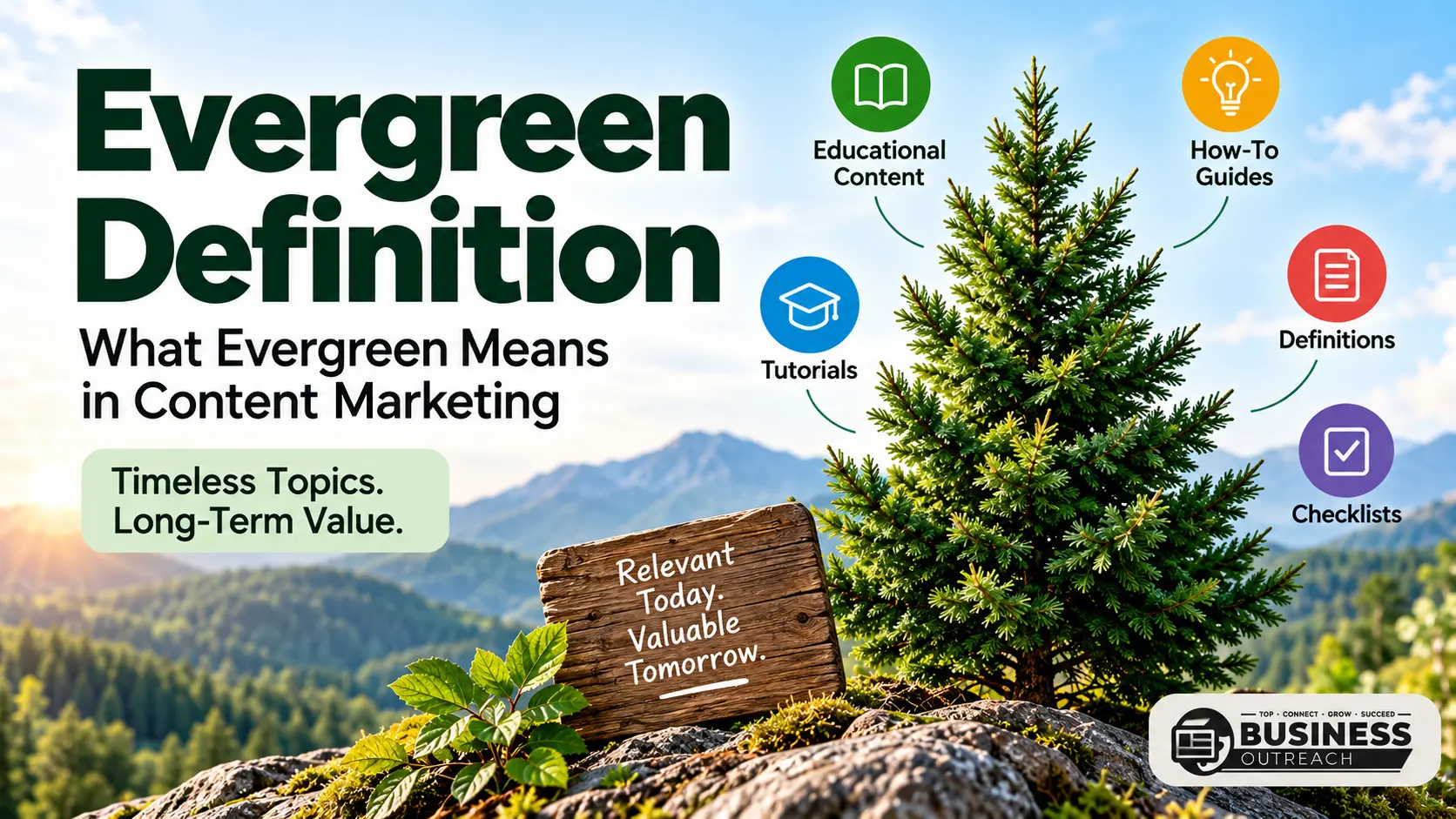
Evergreen refers to something that remains relevant, useful, or valuable over a long period. In content marketing, evergreen content covers topics that keep audiences interested over time, rather than short-lived trends or news. Examples include how-to guides, definitions, tutorials, and educational resources, although these pieces may still require occasional updates.
What Is the Definition of Evergreen?
Simply put, evergreen content remains relevant, useful, or valuable for a long time instead of quickly becoming outdated. The word originally described plants that keep their leaves year-round. Over time, “evergreen” became a broader term used for things that maintain their usefulness or appeal over an extended period. In marketing, publishing, and digital media, evergreen usually describes content that is not strongly tied to a specific date, event, season, or temporary trend. For example, a guide explaining how to create a marketing plan may remain useful for years because businesses will continue needing that information. A post covering a marketing conference happening this month, however, will lose much of its relevance once the event has passed. The term therefore refers to lasting relevance.
What Does Evergreen Mean in Marketing?
In marketing, evergreen means content that continues providing value to its intended audience long after it is first published. Evergreen marketing content usually focuses on recurring questions, stable problems, educational topics, or subjects that people continue researching over time. For example, people will likely continue searching for information about:
- How to write a business plan
- What email marketing is
- How content marketing works
- Basic SEO concepts
- How to create a marketing strategy
- How to improve website usability
These subjects are not dependent on a particular week or year. A marketer can publish an article on one of these topics and continue using it as a resource for months or years, as long as the information remains accurate. This is different from content based on breaking news, yearly trends, temporary promotions, or seasonal events.
What Is Evergreen Content?
Evergreen content is content created around a subject that maintains long-term audience interest. It can take many forms, including blog posts, guides, tutorials, educational resources, videos, glossaries, checklists, and FAQ pages. Evergreen content isn’t defined by its format alone. The topic itself also needs lasting relevance. A tutorial called “How to Write a Professional Email” can be evergreen because the core problem continues to exist. A post called “Best Marketing Trends for 2026” is naturally time-sensitive because readers will eventually start searching for newer trends. The underlying topic therefore determines whether a piece has genuine evergreen potential.
Evergreen Topic vs Evergreen Article
An evergreen topic and an evergreen article are related but should not be treated as the same thing. An evergreen topic has lasting interest. People continue asking about or searching for it over time. An evergreen article is a specific piece of content created around that topic. For example, “how to start a blog” can be an evergreen topic. A detailed guide explaining the process can become evergreen content. However, the article itself can still become outdated if it includes old screenshots, discontinued tools, incorrect instructions, or outdated recommendations. Choosing an evergreen topic is only the first step. Maintaining the article is what helps preserve its usefulness.
Does Evergreen Mean Timeless?
Evergreen and timeless are similar concepts, but they are not always identical. Truly timeless information changes very little. An evergreen article may still include supporting details that become outdated even when its main subject remains relevant.
For example, an article explaining the basics of email marketing may remain useful for years. However, screenshots of an email platform or examples of specific software features may eventually need replacing. It is therefore more accurate to think of evergreen content as long-lasting rather than permanent.
What Are Examples of Evergreen Content?
Evergreen content commonly appears in formats designed to answer recurring questions or teach stable concepts.
Common examples include:
- How-to guides
- Beginner guides
- Tutorials
- Definitions
- Glossaries
- Checklists
- Educational explainers
- Frequently asked questions
- Step-by-step resources
- Basic reference articles
Consider these examples:
| Evergreen Example | Time-Sensitive Example |
| How to create a content strategy | Content marketing trends for 2026 |
| What is email marketing? | Latest email marketing news |
| Beginner’s guide to SEO | This month’s Google update |
| How to write a business plan | Business predictions for next year |
| Social media marketing basics | Viral social media trends this week |
The difference is mainly the expected lifespan of reader interest. Someone could still reasonably search for “how to write a business plan” several years from now. A search for “business predictions for 2026” becomes far less useful after that year ends.
Evergreen vs Trending, Seasonal, and News Content
Evergreen content is only one part of a complete content strategy. Trending, seasonal, and news content can also be useful, but they operate differently.
Evergreen Content
Evergreen content addresses topics with ongoing interest. Its usefulness is not strongly tied to a particular date. A strong evergreen resource may continue attracting readers long after publication.
Trending Content
Trending content focuses on subjects experiencing a sudden increase in attention. This might include a viral marketing technique, a newly popular platform, or a widely discussed industry development. Trending content can generate considerable short-term attention, but interest may decline quickly when the conversation moves elsewhere.
Seasonal Content
Seasonal content becomes more relevant at specific times of the year. Examples include Christmas marketing ideas, Black Friday campaign tips, or summer travel content. The topic may return every year, but demand rises and falls according to the season.
News Content
News content is directly connected to recent events. Its purpose is usually to inform readers about what just happened. A company announcement, algorithm change, product launch, or major industry event can justify news coverage, even if that article eventually loses much of its search demand. A strong marketing strategy can use all four content types rather than relying entirely on evergreen articles.
Why Is Evergreen Content Important in Marketing?
Evergreen content matters because it can continue serving readers without depending entirely on short-term attention. For businesses and marketers, this can make content production more sustainable.
Supports Long-Term Usefulness
A high-quality evergreen guide can remain useful for a long period. Instead of helping readers only during one news cycle or campaign, it can continue answering recurring questions. This gives the content a longer practical lifespan.
Can Support Organic Search Traffic
Many evergreen topics have continuing search demand. If an article matches search intent, provides useful information, and remains accurate, it may continue attracting organic visitors over time.
However, evergreen content does not guarantee rankings. Competition, site authority, content quality, technical SEO, backlinks, and search behaviour can all affect performance. The advantage is that an evergreen topic gives content more opportunity to stay relevant.
Improves Content Efficiency
Producing strong content takes time. Research, writing, editing, design, and publishing all require resources. If a useful guide keeps performing for months or years, marketers get more value from the original work than from content that becomes irrelevant after a few days. Marketers can also reuse evergreen resources in newsletters, social posts, internal training, and other marketing materials.
Helps Build Useful Website Resources
Businesses offering content marketing services can also use evergreen resources to answer recurring audience questions and build a useful library of information over time. For example, a marketing website might create long-term guides around SEO, email marketing, content strategy, customer research, and social media fundamentals. Instead of publishing isolated posts, these resources can gradually strengthen the site’s overall educational value.
What Makes a Topic Evergreen?
A topic is evergreen when people are likely to continue needing information about it over an extended period. Several characteristics can indicate evergreen potential.
Consistent Reader Interest
Evergreen topics usually solve recurring problems. People may keep searching for basic explanations, tutorials, definitions, and processes because new readers keep asking the same questions over time.
Stable Core Information
The basic answer should not change dramatically every few weeks. A topic can still evolve, but its central concept needs enough stability to keep the content useful.
Limited Dependence on Dates
Evergreen topics usually do not depend heavily on a specific year, month, event, or season. Adding dates unnecessarily can make otherwise useful content appear outdated sooner than needed.
Long-Lasting Problems
Recurring business and marketing problems often create good evergreen topics. Companies will continue needing help with customer communication, content planning, marketing strategy, SEO fundamentals, and many other established activities.
Does Evergreen Content Need to Be Updated?
Yes. Evergreen content can and often should be updated. Evergreen describes a topic’s continued relevance, not the permanent accuracy of every detail in the article.
Content reviews may reveal outdated:
- Statistics
- Screenshots
- Examples
- Software instructions
- Product information
- Tool recommendations
- Terminology
- Supporting facts
The amount of maintenance required depends on the subject. A basic definition might remain accurate for years, while a software tutorial could need updates whenever the platform changes its interface. Updates should improve accuracy and usefulness, not just change the publication date.
Common Misunderstandings About Evergreen Content
One common misunderstanding is that evergreen content can be published once and ignored forever. That is rarely a good approach. Another misconception is that every how-to guide is automatically evergreen. A tutorial about a rapidly changing platform can become outdated quickly, even if it uses a traditional evergreen format.
Evergreen content also does not guarantee SEO success. A topic may have lasting interest but still be highly competitive. Poorly researched or unhelpful content will not automatically perform simply because the subject is evergreen. It is also incorrect to assume that trending content has no value. Timely content can help marketers respond to current conversations, industry developments, product launches, or seasonal opportunities. The strongest strategies often combine long-lasting resources with carefully chosen timely pieces.
Frequently Asked Questions
What is the simple definition of evergreen?
Evergreen means something that stays relevant, useful, or valuable over an extended period. In content and marketing, it usually refers to information that continues helping readers after publication rather than becoming quickly outdated because of a specific date, trend, or event.
What does evergreen mean in marketing?
In marketing, evergreen describes content or campaigns that stay relevant over time. Evergreen content usually addresses recurring questions, stable problems, or educational topics that audiences continue caring about over time.
What is an example of evergreen content?
A beginner’s guide to content marketing is a good evergreen example because people will continue wanting to understand the subject. Other examples include tutorials, definitions, checklists, glossaries, and basic how-to guides.
Is evergreen content the same as timeless content?
Not exactly. Evergreen content has long-term relevance, but some details may still need updating. Truly timeless content changes little, while evergreen content may need maintenance to keep statistics, examples, screenshots, or recommendations accurate.
How long can evergreen content stay relevant?
There is no fixed lifespan. Some evergreen content can remain relevant for many years, while other articles require more frequent updates. Longevity depends on the topic’s stability, industry changes, and how well you maintain the content.
Final Thoughts
The evergreen definition is ultimately about lasting relevance. In marketing, evergreen content focuses on topics that continue helping readers beyond a short trend, season, or news cycle. The best evergreen content combines a stable topic with accurate information and periodic maintenance, allowing it to remain a useful part of a marketing strategy over time.