SaaS Business Model: How It Works, Revenue, Pricing and Growth
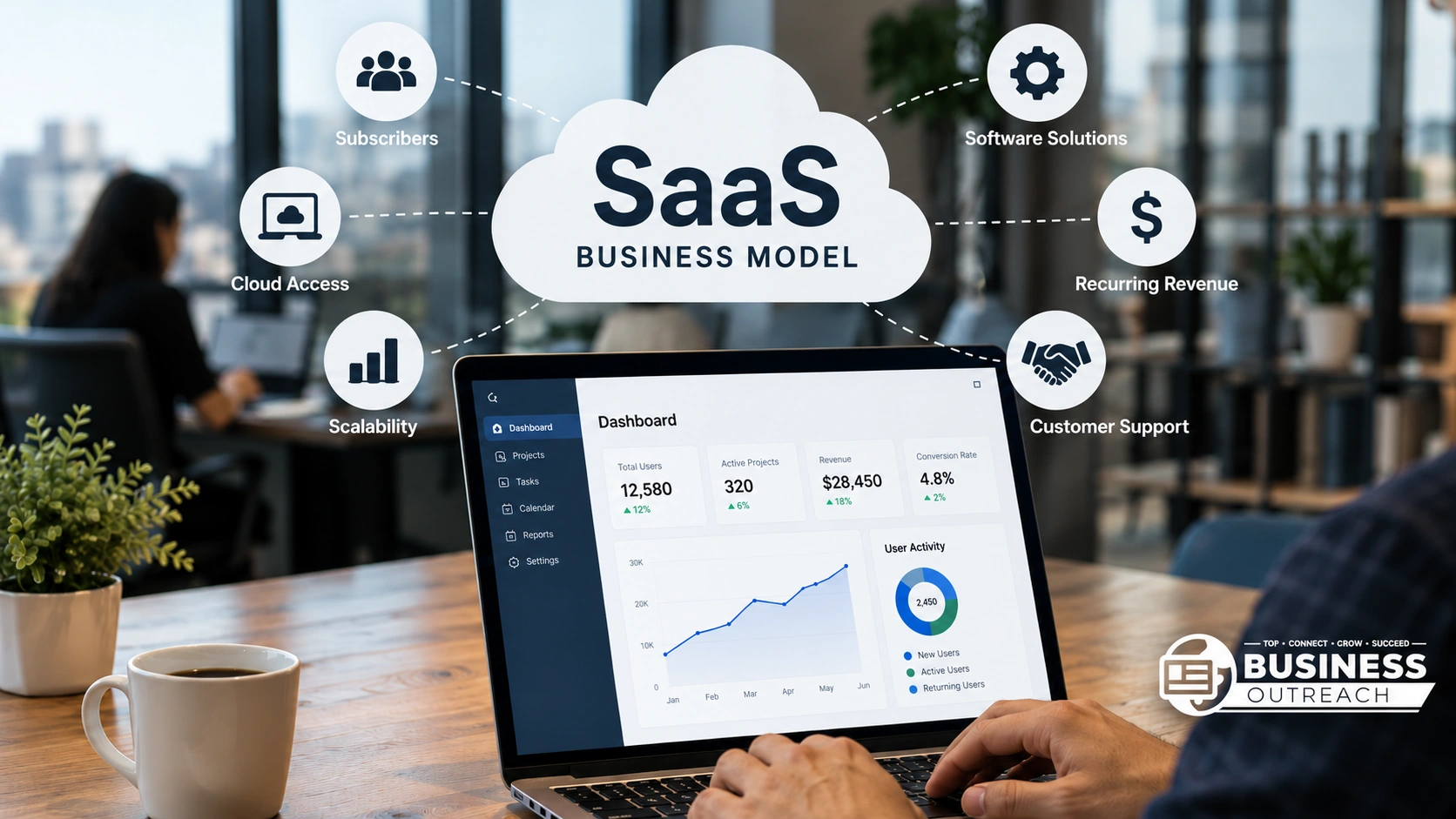
The SaaS business model has changed how many software companies build, deliver, and monetize digital products. Instead of selling a program once and leaving customers to manage it, SaaS providers typically deliver software online and maintain an ongoing relationship with users. Revenue may come from subscriptions, usage charges, per-user pricing, or a combination of methods. Understanding the model therefore requires looking at pricing, acquisition, retention, costs, recurring revenue, and continued product value together.
A SaaS business model delivers software continuously over the internet while generating revenue through subscriptions, usage charges, per-user pricing, or hybrid structures. Its performance depends on more than attracting new customers. Pricing, activation, retention, churn, expansion revenue, acquisition costs, infrastructure expenses, and continued product value all influence sustainable growth.
What Is a SaaS Business Model?
SaaS stands for Software as a Service. Customers generally access the software online while the provider manages the application, updates, maintenance, and much of the underlying infrastructure.
The commercial relationship is usually ongoing rather than based on a single software sale. Customers may pay monthly, annually, by usage, by the number of users, or through another pricing structure. For that reason, SaaS should not automatically be treated as another name for a monthly subscription.
How Does the SaaS Business Model Work?
A SaaS company develops software that solves a customer problem, keeps the product continuously available, and charges users under an agreed pricing model. The company then needs to attract the right customers, help them realize value, retain them, and support the product over time.
Customer Problem → SaaS Product → Pricing → Acquisition → Conversion → Retention → Expansion
Every stage matters. Strong acquisition can’t indefinitely compensate for high churn, and excellent retention doesn’t automatically create a healthy business if acquiring or serving customers is too expensive.
How Do SaaS Companies Make Money?
Many SaaS companies earn revenue by charging customers for continued access to software. Payments may be monthly or annual, while other businesses charge by seat, transaction, storage, API requests, or another measure of usage.
Revenue can also grow within an existing account. A customer might add employees, increase usage, purchase an additional feature, or move to a higher plan. This makes expansion revenue an important part of many SaaS models.
Recurring billing can improve revenue visibility, but it does not guarantee recurring income. Customers may cancel, downgrade, reduce usage, or move to another product.
Common SaaS Pricing Models
Many SaaS companies use a subscription business model, although subscriptions are only one way to structure pricing. The right approach depends on the product, customer segment, and how customers receive value.
| Flat Rate | One standard price | Simple products |
| Per User | Price changes with seats | Team software |
| Tiered | Several plans with different features | Multiple customer segments |
| Usage Based | Charges depend on consumption | APIs and infrastructure |
| Freemium | Basic product is free | Low-friction adoption |
| Hybrid | Combines pricing methods | More complex products |
Pricing and packaging are related but different. Pricing determines how much customers pay and on what basis, while packaging determines which features, limits, or services are included.
Recurring Revenue, MRR and ARR
Recurring revenue is one of the characteristics most closely associated with SaaS. When customers continue paying for access, the company can build a revenue base that carries from one billing period into the next.
Monthly Recurring Revenue (MRR) describes recurring revenue monthly, while Annual Recurring Revenue (ARR) expresses it annually. Companies may calculate these figures differently when contracts contain discounts, variable usage, one-time fees, or professional services.
Neither MRR nor ARR should be viewed as proof of profitability. They show recurring revenue scale, not the complete economics of operating the company.
Customer Acquisition and CAC
SaaS companies can acquire customers through search, content marketing, advertising, referrals, partnerships, direct sales, free trials, freemium plans, and product-led acquisition.
The right channel often depends on the customer. A low-cost, self-service product may rely heavily on online signups, while enterprise software may require demos, procurement reviews, technical evaluations, and sales conversations.
Customer Acquisition Cost (CAC) helps estimate what a company spends to gain new customers. Low CAC may look attractive, but it has little value if acquired customers generate limited revenue or leave shortly after joining.
Activation, Onboarding and Time-to-Value
Acquisition brings a user into the product, but onboarding helps that user reach a useful outcome. Depending on the software, onboarding may involve account setup, product tours, integrations, documentation, templates, implementation assistance, or customer support.
Activation occurs when a user reaches an important point that demonstrates the product’s value. Closely related is time-to-value: how quickly a customer gets a meaningful benefit after signing up.
Clear Onboarding → Faster Activation → Earlier Value Recognition → Better Retention Potential
This relationship isn’t guaranteed, but poor onboarding can make even a useful product hard to adopt.
Customer Retention and Churn
Retention measures how effectively a SaaS business keeps customers or recurring revenue over time. Churn measures what is lost through cancellations, non-renewals, downgrades, or reduced usage.
Customer churn and revenue churn can tell different stories. A company could lose several small accounts while a larger customer expands, reducing the customer count without a proportional drop in revenue.
This is why acquisition figures should never be read alone. A business that constantly replaces departing customers may appear to be growing while underlying retention remains weak.
Expansion Revenue and SaaS Growth
Growth does not always require a completely new customer. Existing accounts may generate more revenue when customers add users, increase consumption, adopt new features, or upgrade plans.
New Revenue + Expansion Revenue − Lost Revenue = Recurring Revenue Movement
This is not a universal accounting formula. It simply shows how acquisition, expansion, downgrades, and churn interact. Strong SaaS growth usually requires attention to both sides of the equation: bringing in suitable customers and maintaining valuable existing relationships.
Key SaaS Metrics
No single metric can explain the health of a SaaS business. Several measures are usually considered together.
| MRR | Monthly recurring revenue |
| ARR | Annualized recurring revenue |
| CAC | Cost of acquiring customers |
| LTV | Estimated lifetime customer value |
| Churn | Customers or revenue lost |
| Retention | Customers or revenue maintained |
| ARPU | Average revenue per user or account |
| Expansion Revenue | Additional revenue from existing accounts |
A company can report rising revenue while facing weak retention, high acquisition costs, or rapidly increasing service expenses. Context matters more than an isolated number.
Customer Lifetime Value and Payback
Customer Lifetime Value (LTV) estimates the economic value a customer relationship may create over time. It depends on revenue per customer, expected retention, margins, customer lifespan, and potential account expansion. Because these inputs can change, LTV is an estimate, not guaranteed future revenue.
SaaS businesses may also consider how long it takes to recover acquisition spending. If acquiring a customer requires significant sales and marketing investment, the business needs enough revenue or margin from that relationship to recover the cost. There is no single ideal payback period that applies to every SaaS company.
Pricing Metrics and Usage-Based Models
The price itself is only one part of SaaS monetization. Another important decision is the pricing metric—the unit that determines how the bill changes.
- users or seats
- transactions
- API requests
- storage
- accounts
- feature access
- overall consumption
Usage-based pricing can align the bill more closely with consumption, particularly for infrastructure or developer products. However, it may also make customer bills and company revenue less predictable. Some SaaS companies use hybrid pricing, combining a base subscription with variable usage charges.
Does Freemium Work for SaaS?
Freemium lets users access a basic version of the product for free while reserving additional features, usage, or capacity for paid plans.
The model can reduce friction and let users try the product before buying. However, free users still create infrastructure and support costs. If too few users upgrade, a large free user base can become expensive without producing enough revenue.
Freemium therefore works best when free usage is economically manageable, and the paid product offers a clear reason to upgrade.
Major Costs in a SaaS Business
SaaS distribution can be efficient, but running a software service isn’t cost-free. Major expenses may include product development, engineering, hosting, data storage, cybersecurity, billing systems, customer support, sales, marketing, and administration.
These costs can change as the company grows. More customers may require additional infrastructure, support staff, security controls, and operational processes.
Revenue Growth ≠ Profit Growth
A company can increase recurring revenue while also increasing expenses rapidly. Sustainable performance depends on the economics behind the growth.
Advantages of the SaaS Business Model
One major advantage is the potential to build recurring customer relationships rather than depending entirely on one-time sales. Continued access can also make revenue easier to plan when retention remains healthy.
Online delivery lets providers release updates centrally and deliver improvements without requiring customers to buy an entirely new software version. SaaS businesses can also support different pricing structures and expand successful customer accounts over time. These advantages depend on execution. Poor retention, weak product value, or high operating costs can reduce their impact.
Disadvantages and Risks of SaaS
SaaS companies must continuously deliver a reliable service. Customers expect the software to remain available, secure, useful, and regularly improved.
- customer churn
- high acquisition costs
- cybersecurity problems
- infrastructure expenses
- pricing pressure
- strong competition
- customer-support demands
- continued development costs
Scaling can also create operational complexity. More users can mean more infrastructure, more support, and more security requirements, not just more revenue.
SaaS vs Traditional Software Business Model
Traditional software has historically relied more heavily on upfront licensing and customer-managed installation. SaaS shifts more ongoing service responsibility to the provider.
| Delivery | Usually online | Often installed locally |
| Pricing | Recurring or usage-based common | Upfront licenses common |
| Updates | Commonly provider managed | May require installation |
| Relationship | Ongoing | Can be transaction focused |
| Revenue Timing | Spread across relationship | More may arrive upfront |
| Infrastructure | Provider manages more | Customer may manage more |
Neither structure is automatically better. The right model depends on the software, target customer, technical requirements, and commercial strategy.
B2B and B2C SaaS Models
B2B SaaS sells mainly to organizations. These products may involve multiple seats, larger contracts, account managers, implementation support, and longer purchasing processes. B2C SaaS primarily serves individual consumers. Self-service purchasing, simpler onboarding, lower individual account values, and higher user volumes may be more common. These are general patterns rather than strict rules. A single SaaS company can serve individuals, small teams, and large organizations with different plans.
Example of a SaaS Business Model
Consider a fictional project-management platform that charges businesses per active user. A company begins with ten seats after completing a free trial.
Revenue increases if the customer adds employees or moves to a higher plan. Revenue falls if the company removes seats, downgrades, or cancels. Meanwhile, the provider continues paying for infrastructure, development, security, customer support, and acquisition.
This simple example shows why SaaS performance depends on more than signup numbers. Pricing, retention, expansion, and operating costs interact throughout the customer relationship.
What Makes a SaaS Business Model Sustainable?
A sustainable business model begins with a problem customers repeatedly need to solve. The product then needs to deliver enough continuing value for customers to keep using and paying for it.
Problem → Product Value → Pricing → Acquisition → Activation → Retention → Expansion → Economics → Costs
Product-market fit should come before aggressive scaling. If customers regularly leave because the product doesn’t solve their problem, more marketing may increase acquisition without fixing the underlying weakness.
How to Evaluate a SaaS Business Model
A practical evaluation can follow this sequence:
| Acquire | Can the business reach suitable customers efficiently? |
| Convert | Do prospects become paying users? |
| Activate | Do customers experience meaningful value? |
| Retain | Do they continue using and paying? |
| Expand | Can successful accounts grow? |
| Measure | Are customer and revenue economics improving? |
| Improve | Can the product and operations become stronger? |
Looking at the complete system prevents one impressive metric from hiding problems elsewhere. For entrepreneurs evaluating a new software idea, this analysis can also inform a business plan, because pricing, customer acquisition, operating costs, and retention directly affect the commercial model.
Common SaaS Business Model Mistakes
A common mistake is building extensively before confirming that customers have a recurring problem worth paying to solve. Another is focusing heavily on customer acquisition while giving too little attention to activation and churn.
Businesses may also make pricing unnecessarily complex, offer too many plans, underestimate support costs, or assume freemium will automatically produce paid customers. The biggest mistake is often treating growth as proof that the entire business works. Consider revenue, retention, acquisition costs, infrastructure expenses, and customer value together.
FAQs
What is a SaaS business model?
A SaaS business model delivers software as an ongoing online service rather than depending primarily on one-time software sales. Customers may pay through subscriptions, usage charges, per-user pricing, or combinations of these approaches.
How does a SaaS company make money?
A SaaS company can generate revenue through monthly or annual subscriptions, per-user charges, usage-based billing, feature upgrades, additional products, and expansion within existing customer accounts.
Is SaaS always subscription-based?
No. Subscriptions are common, but SaaS companies can also use usage-based, per-user, tiered, freemium, or hybrid pricing structures.
What are the main SaaS pricing models?
Common models include flat-rate, per-user, tiered, usage-based, freemium, feature-based, and hybrid pricing. The right approach depends on the product and how customers receive value.
What metrics are important for a SaaS business?
Common SaaS metrics include MRR, ARR, CAC, LTV, churn, retention, ARPU, and expansion revenue. They are most useful when evaluated together rather than individually.
What is the difference between SaaS and traditional software?
SaaS is generally delivered online and continuously maintained by the provider, with recurring or usage-based pricing. Traditional software has historically relied more heavily on upfront licenses and customer-managed installation or infrastructure.
Final Thoughts
A SaaS business model is more than charging customers every month. Sustainable performance depends on solving a recurring problem, delivering continuous value, choosing suitable pricing, acquiring customers efficiently, retaining useful accounts, managing churn, and controlling the costs required to operate and improve the service.


One Comment