Business Model: Definition, Types, Examples, and How It Works
A business model explains how a company creates value for customers, delivers that value, and earns enough revenue to support its operations. It connects the customer problem, product or service, pricing, distribution, resources, activities, and costs into one working system. Whether a company sells software, physical products, services, subscriptions, or advertising, its business model shows how it turns customer demand into sustainable economic activity.
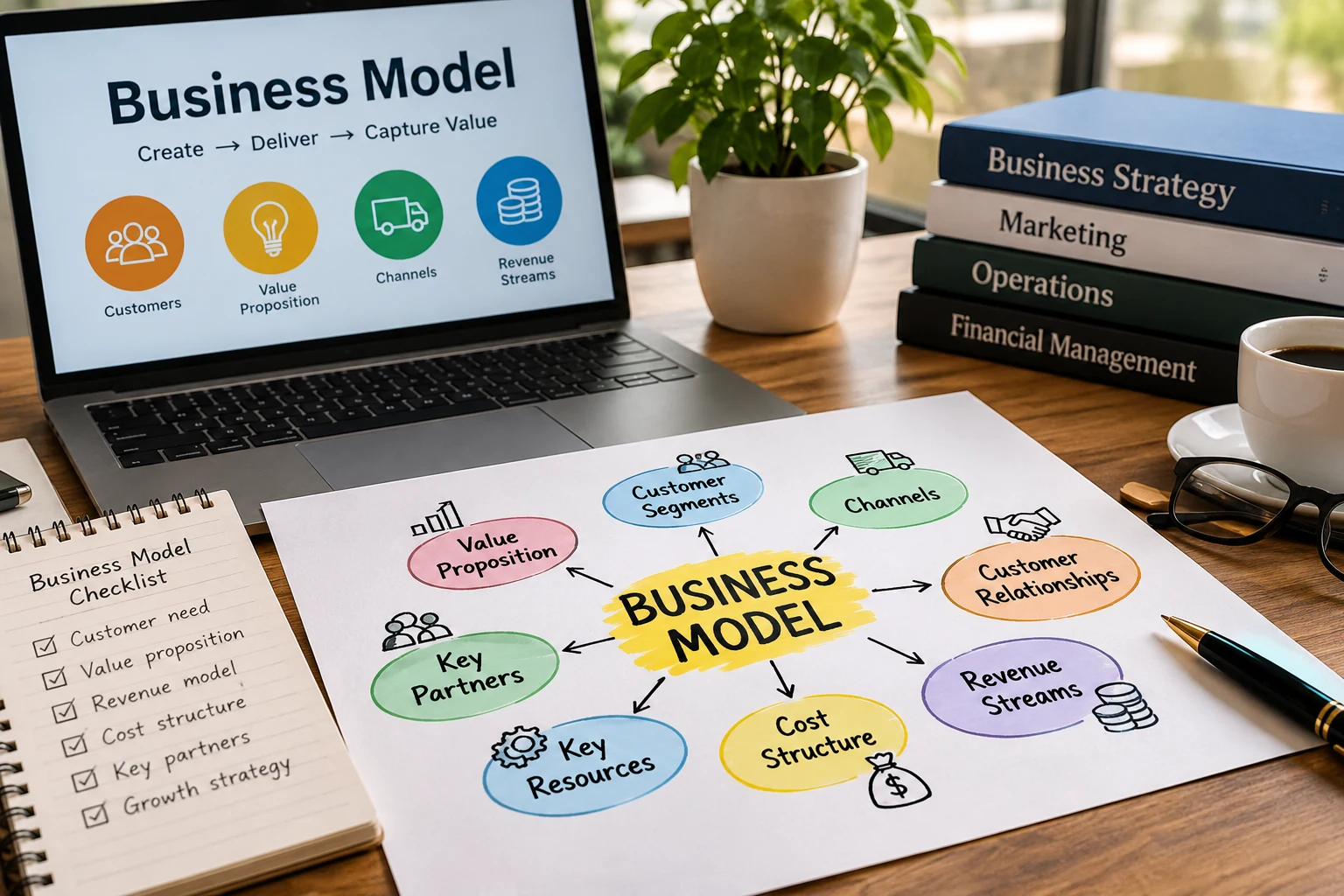
A business model describes how a company serves customers and creates economic value. It typically includes the value proposition, customer segments, revenue streams, cost structure, channels, resources, activities, and partnerships. Strong models align customer needs with an effective delivery system and a revenue structure that supports long-term operations.
What Is a Business Model?
A business model is the overall system a company uses to create, deliver, and capture value. In simple terms, it explains who the customer is, what the company offers, how it reaches the customer, how it earns money, and what it costs to operate.
The concept is broader than simply deciding what product to sell. Two businesses can offer similar products while operating very differently. One may sell directly through its website, while another relies on distributors. One may charge a one-time fee, while another uses subscriptions or usage-based pricing.
A workable model must connect customer value with business economics. If customers like the offer but the company cannot cover its costs, the model may not be sustainable. If the economics look attractive but customers do not value the offer, demand becomes the problem.
How Does a Business Model Work?
A business model usually begins with a customer need or problem. The company develops a value proposition to address that need and then decides how the product or service will reach the customer.
The business also needs a way to capture economic value. That could involve direct sales, subscriptions, transaction fees, advertising, licensing, usage charges, or several methods operating together.
Behind the offer are resources, activities, partners, and costs. A software company may depend on developers and cloud infrastructure, while a retailer may rely more heavily on inventory, suppliers, stores, and logistics.
Customer need → Value proposition → Delivery → Revenue → Costs → Sustainable operation
A strong model keeps these elements aligned instead of treating them as separate decisions.
What Are the Main Components of a Business Model?
Value Proposition
The value proposition explains why customers should choose the company’s product or service. Value may come from price, convenience, speed, quality, specialization, reliability, access, design, or another meaningful benefit.
Customer Segments
Customer segments define who the business serves. These could include consumers, small businesses, enterprises, professionals, students, sellers, or advertisers. Different segments may require different pricing, marketing, support, or distribution.
Channels
Channels describe how the business reaches customers and delivers value. Common examples include websites, mobile apps, physical stores, sales teams, marketplaces, distributors, and partners.
Customer Relationships
This component explains how the business attracts, supports, and retains customers. Relationships may involve self-service, automated onboarding, account management, customer support, communities, or recurring subscriptions.
Revenue Streams
Revenue streams show how the company earns money. Common examples include sales, subscriptions, commissions, transaction fees, advertising, licensing, royalties, and usage-based charges. A revenue stream is only one part of the wider business model.
Key Resources and Activities
Key resources are the assets needed to operate, such as employees, technology, intellectual property, inventory, capital, or infrastructure. Key activities are the tasks the company must perform well, such as software development, manufacturing, logistics, sales, marketing, or customer support.
Key Partners
Partners can include suppliers, manufacturers, payment processors, technology providers, logistics companies, distributors, and franchisees. They can help the company reduce costs, expand reach, or gain capabilities it doesn’t want to build internally.
Cost Structure
The cost structure includes the major expenses required to operate the business, such as salaries, inventory, marketing, technology, logistics, rent, infrastructure, and customer support. Revenue must cover these costs for the model to remain economically viable.
Common Types of Business Models
Subscription Model
Customers pay recurring fees for continued access to a product or service. This model is common in software, memberships, media, education, and recurring product delivery.
Marketplace Model
A marketplace connects groups such as buyers and sellers and typically earns through commissions, transaction fees, subscriptions, advertising, or related services.
Freemium Model
Basic access is free, while advanced features or higher usage limits require payment. The model depends on converting enough free users into paying customers.
Direct Sales Model
The company sells directly to the end customer rather than relying mainly on intermediaries. This gives the company more control over pricing and customer relationships.
Advertising Model
The business attracts an audience and earns revenue from advertisers who want access to it. This is common in media and digital platforms.
Licensing Model
The company allows another organization to use its intellectual property, technology, software, designs, or brand in exchange for fees or royalties.
Franchise Model
Independent operators use an established brand, system, and operating format. The franchisor may earn initial fees, ongoing royalties, or other payments.
Usage-Based Model
Customers pay according to how much they use. Examples include cloud computing, API calls, storage, and transaction-based services.
Razor-and-Blades Model
The business sells a core product and then earns recurring revenue from complementary products, consumables, or replacement items.
Business Model Examples
Different industries use different structures depending on how they deliver and monetise value.
| Example | Main Model | How Value Is Monetized |
| SaaS company | Subscription | Monthly or annual fees |
| Online marketplace | Marketplace | Commissions and service fees |
| Media platform | Advertising | Advertiser payments |
| Franchise business | Franchise | Fees and royalties |
| Software provider | Licensing | License payments |
| Cloud platform | Usage-based | Charges based on consumption |
These examples are simplified. Many real businesses use hybrid models. For example, a software provider may combine subscriptions, usage fees, premium support, and marketplace commissions. A retailer might combine direct sales, subscriptions, advertising, and third-party marketplace services.
The better question is often not “Which single model does this company use?” but “How do its different revenue and value mechanisms work together?”
Business Model vs Revenue Model
A business model and revenue model are related, but they are not the same.
| Business Model | Revenue Model |
| Describes the complete operating system | Describes how money is earned |
| Includes customers and value proposition | Focuses on monetization |
| Includes resources, partners, and costs | Covers sales, fees, subscriptions, ads, etc. |
| Explains value creation and delivery | Explains revenue capture |
For example, a marketplace may connect buyers and sellers, manage transactions, and provide payments or trust mechanisms. Its revenue model may then use commissions, subscriptions, listing fees, or advertising. The revenue model is therefore one component inside the broader business model.
Business Model vs Business Plan
A business model explains the fundamental logic of how a company works. A business plan is a broader planning document that may include market research, business goals, competitive analysis, marketing, operations, hiring, financing, and financial projections.
The business model answers questions such as: Who is the customer? What value are we offering? How will we deliver it? How will we earn money? The business plan goes further by explaining how the company intends to execute and develop those ideas over time.
What Is the Business Model Canvas?
The Business Model Canvas is a visual framework used to organize the main parts of a business model on one page.
- Customer Segments
- Value Propositions
- Channels
- Customer Relationships
- Revenue Streams
- Key Resources
- Key Activities
- Key Partnerships
- Cost Structure
The framework helps teams see how the model’s parts connect. For example, a change in customer segment may affect the value proposition, pricing, channels, resources, and costs. The canvas is useful for mapping assumptions, but it does not replace detailed market research, financial analysis, or execution planning.
How to Create a Business Model
Start by identifying the target customer and the problem that needs to be solved. Avoid beginning with a product idea without first understanding whether a meaningful customer need exists. Next, define the value proposition. The offer should clearly explain why a customer would choose your solution instead of another option or doing nothing.
Choose the channels through which customers will discover, buy, and use the product or service. Then decide how the business will earn revenue, whether through direct sales, subscriptions, commissions, advertising, licensing, usage fees, or another method.
Identify the resources, activities, and partnerships required to deliver the offer. Estimate major costs such as acquisition, operations, delivery, support, technology, and infrastructure. Finally, test the assumptions. Customer interviews, prototypes, pilot programs, early sales, and usage data can reveal whether the model works in practice. The goal is not to design a perfect model on paper. It is to create one that can be tested and improved with evidence.
How to Evaluate a Business Model
A useful evaluation starts with customer demand. Ask whether the model solves a genuine problem and whether customers are willing to pay for the solution. Next, examine the economics. Revenue should cover customer acquisition, product delivery, operations, support, and other costs. Unit economics can help show whether an individual customer, order, subscription, or transaction creates enough economic value.
Scalability also matters. A scalable model can increase revenue without every cost rising at the same rate, although growth may still require more people, technology, marketing, or infrastructure. Finally, look at differentiation. A model may be stronger if it benefits from lower costs, better distribution, network effects, proprietary technology, a strong brand, or a superior customer experience.
Common Business Model Mistakes
One common mistake is failing to clearly define the target customer. If the audience is too broad, the value proposition and marketing can become unfocused. Another is confusing revenue with profit. A company can generate strong sales and still lose money if costs are too high.
Businesses may also copy competitors without validating whether the same assumptions apply to their own market, customers, resources, or cost structure. Overestimating scalability is another risk. Growth may require additional employees, infrastructure, support, compliance, or marketing spending that early assumptions didn’t include.
Finally, businesses sometimes treat their first model as permanent. Markets, technology, customer behaviour, competition, and costs can change, so the model may need to evolve.
FAQs
What is a business model in simple terms?
A business model explains how a company serves customers, delivers a product or service, earns revenue, and manages the resources and costs required to operate.
What are the main parts of a business model?
Common components include customer segments, value proposition, channels, customer relationships, revenue streams, key resources, key activities, partnerships, and cost structure.
What are common types of business models?
Common types include subscription, marketplace, direct sales, freemium, advertising, licensing, franchise, usage-based, and razor-and-blades models.
What is the difference between a business model and a revenue model?
A business model describes the entire system for creating, delivering, and capturing value. A revenue model focuses specifically on how the company earns money.
What is the difference between a business model and a business plan?
A business model explains how the business fundamentally works. A business plan is a broader document covering goals, market analysis, operations, strategy, execution, and financial planning.
Can a company use more than one business model?
Yes. Many companies use hybrid structures that combine several models or revenue streams, such as subscriptions, direct sales, advertising, commissions, or usage-based pricing.
Final Thoughts
A strong business model connects customer needs, value delivery, revenue, resources, and costs into a workable economic system. The most effective models are built around clear customer value, realistic economics, and the ability to adapt as the market and business evolve.